Medieval Studies has a white supremacy problem.
Recently, this came knocking on the SCA's door with what's been called "trimgate". Royals outside my kingdom wore a commissioned garment with a trim based on the Snartemo V pattern. I will not link or display the image directly, as it would be a distraction. They have abdicated and their Kingdom is in a healing process right now. I'm not here to interrupt or otherwise impede the healing of another Kingdom, my Kingdom is still healing from its own, very different, trauma.
What I want to unpack is what I'm seeing as an aftermath. This is a departure from my usual writing, so if you've come here for research updates and the like, this is an entry you can certainly skip. I feel compelled to say something, anything, in the effort that my words can help explain what so many people are still feeling, and it requires me to break down the fantasy and build in the very real person who does the research into the hypothetical Erdeneqadajin.
I am a white gay man, and a father to two beautiful black children. My entire life outside the SCA is looks and judgments. I come to the SCA as an escape from the grind of life. Much of my found family plays the game; we encourage each other and support each other.
What I'm seeing is that this is not the rule, but rather the exception for people like me.
If you clicked on the link for the Snartemo V pattern, you can see the original is believed to have a fylfot, or Norse swastika. The interpretation that is causing the outrage took the swatiska, and matched it with other symbols of the Nazi party and the neo-Nazi movement. Whether this is based on an academic interpretation of the weave, or infused with artistic license, I don't think matters. What does matter is that it was there, large, in photographs for the SCA, devoid of context.
What matters more is that when there was an outrage, a justifiable outrage, those people were made to be the problem. They were told they were opposed to historicism, that the history of the garment outweighed the real history that came after it. The glossing over of the co-opting of Norse history by white supremacy and what could have been a real discussion of how the SCA, which is increasingly seeing a surge of Viking-age personae, separates people who are lovers of the real history of the Vikings from those who use the fantasy of Aryan crusaders ridding the world of non-Aryan people.
This echos the complaints about the harassment policy put in place to help combat bullying and sexual harassment that needed addressing right before the #MeToo movement exploded into consciousness. Where "the SJWs are ruining the game" with their "PC nonsense".
Even more, it's the same vein of complaint levied against Inspirational Equality, which was launched directly for people like me, who kept seeing men fight for their wives and wondered what the real harm was if a man wanted to fight for his husband (or wife for wife, of course). Once again, it was the SJWs making problems for the rest of the society, clutching their pearls about things that "weren't important".
At what point, then, do we admit that there is a huge problem with Reactionary Conservatism embedded within the culture of the SCA? When do we soul search and determine who wins -- the people who take into consideration the modern meanings and visuals of what we're doing in conjunction with the history we're looking to be inspired by?
More personally, who gets to feel comfortable in the SCA? The people who think it's ok to put swastika on garb, harass women and keep it straight? or is it the people who think that ignoring the importance of the swastika is Holocaust denial, think that all people should have protection and see no harm in letting other people fully participate?
I don't know if there's really enough people looking for an answer to that. That's a huge problem that needs addressing.
Showing posts with label Extant Examples. Show all posts
Showing posts with label Extant Examples. Show all posts
01 February 2018

28 August 2016
Something Mongol and NOT grammar or titles?! WHAT CRAZY IS THIS
I've put a lot of time into the Grammar and Titles project recently, which has been reflected here, but I also have been looking at my next garb project for generally usable garb -- so not a special challenge or theme.
I'm multi-talented, or maybe ADD, like that. I like to think multi-talented, but sometimes I get bored and my interests wander off to something which isn't my main focus for a while.
I want to make something inspired by this:
Now, you might be thinking "this doesn't look that much different than what you usually do" and you'd be both right and a bit off base.
First, the general construction of Mongol deels hasn't really changed much over the passing centuries. I believe I've talked to the basic construction before, but in case I haven't, the general pattern I have memorized is here. I do some modifications, like I will take out the panel extensions because of the fit I usually do, which is loose in the lower half, but you can see the basics of it in any of the pictures of me I've posted up here for head-to-toe analysis and the like.
Now, unsurprising to most people who study it, but history is messy. People then, like now, don't fall into these discrete and easy groupings, and with that, comes variations across.
In China, the strong influence of the Chinese ethnic groups means that I generally haven't seen the deels like the above. They tend to be less fitted, longer and more simple in design and construction, relying on the strength and prominence of the fabric to do the talking.
The example above, is from the Persian sphere of influence. What that means is that the Mongols changed their deel a bit, the longer they were there, until it becomes the cross-over coat that the early Mughals wore, at least until Period ends in the early 17th century.
It looks like this:
Jumping back, though, I've got some working out to do on the pleating. Pleating is not something I readily understand in terms of how to construct them. I know there are different kinds of pleats which sit different ways.
First, a close up of the pleating:
I really enjoy this detail shot because I have seen numerous examples from the Persian sphere of Mongol cross-over coats having this silhouette and general construction pattern.
I was talking with Elvira yesterday about garb fantasies and my sticking points. And there are two with this particular deel construction.
The pleats and the belt. The belt I'll get to in a minute, but the pleats I want to dive into more.
They way they sit they look like cartridge pleats. I've laid out cartridge pleats for other members of the household's garb. I know how to do it, but I have literally no evidence (there's no inside detail shot I can find) that this is, in fact, a type of cartridge pleat.
It's insanely neat and ordered, but without the evidence for cartridge pleating, I have to believe it's probably insanely small, and well organized, gathers. They appear to be sewn in 3 spots: one to the upper part of the coat, one in the center and then one a bit further down to reinforce the drape. Kind of like a proto-smocking, I suppose.
However, I really am not sure. I'll have to experiment, and likely fail, a few times before I work it out.
Now the belt.
That belt is a braided in small, smell braids, then sewn together. As a belt, it is not part of the actual coat itself, but holds it together between the waist and the hips. That's a lot of braiding. I don't braid well. That's a problem.
So, I've got some working out to do, which will require some experimentation. I would not expect as much about this ongoing experiment that I would about the other project, as it's more clear-cut in when I can start and stop, and what that will look like in terms of progress.
I'm multi-talented, or maybe ADD, like that. I like to think multi-talented, but sometimes I get bored and my interests wander off to something which isn't my main focus for a while.
I want to make something inspired by this:
 |
| source |
First, the general construction of Mongol deels hasn't really changed much over the passing centuries. I believe I've talked to the basic construction before, but in case I haven't, the general pattern I have memorized is here. I do some modifications, like I will take out the panel extensions because of the fit I usually do, which is loose in the lower half, but you can see the basics of it in any of the pictures of me I've posted up here for head-to-toe analysis and the like.
Now, unsurprising to most people who study it, but history is messy. People then, like now, don't fall into these discrete and easy groupings, and with that, comes variations across.
In China, the strong influence of the Chinese ethnic groups means that I generally haven't seen the deels like the above. They tend to be less fitted, longer and more simple in design and construction, relying on the strength and prominence of the fabric to do the talking.
The example above, is from the Persian sphere of influence. What that means is that the Mongols changed their deel a bit, the longer they were there, until it becomes the cross-over coat that the early Mughals wore, at least until Period ends in the early 17th century.
It looks like this:
 |
| source |
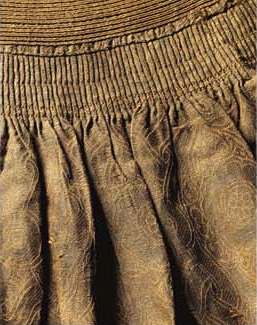
First, a close up of the pleating:
 |
| Same source as extant at beginning |
I was talking with Elvira yesterday about garb fantasies and my sticking points. And there are two with this particular deel construction.
The pleats and the belt. The belt I'll get to in a minute, but the pleats I want to dive into more.
They way they sit they look like cartridge pleats. I've laid out cartridge pleats for other members of the household's garb. I know how to do it, but I have literally no evidence (there's no inside detail shot I can find) that this is, in fact, a type of cartridge pleat.
It's insanely neat and ordered, but without the evidence for cartridge pleating, I have to believe it's probably insanely small, and well organized, gathers. They appear to be sewn in 3 spots: one to the upper part of the coat, one in the center and then one a bit further down to reinforce the drape. Kind of like a proto-smocking, I suppose.
However, I really am not sure. I'll have to experiment, and likely fail, a few times before I work it out.
Now the belt.
That belt is a braided in small, smell braids, then sewn together. As a belt, it is not part of the actual coat itself, but holds it together between the waist and the hips. That's a lot of braiding. I don't braid well. That's a problem.
So, I've got some working out to do, which will require some experimentation. I would not expect as much about this ongoing experiment that I would about the other project, as it's more clear-cut in when I can start and stop, and what that will look like in terms of progress.
06 February 2015
Birka Garb 2015
Within the last few weeks, here in the East Kingdom we had a large event called A Market Day at Birka. It's a merchant-centered event, as the name suggests, at a hotel in Manchester, NH.
Among many events, including an intensely popular armored, heavy combat tournament, is the annual fashion show where those who wish to can show off their duds to the oohs and ahs of the populace.
My household, House Strangewayes, has been running the fashion show for the past several years and it's a big success. As a member of the household, I volunteered to help keep everything running smoothly from registration through the event itself. This means I'm in the background of a good amount of photos around Facebook.
What that allows me, though, is the ability to show you the latest garb I've made and break down my inspirations and documentations for the decisions I made to construct it.

There I am holding the clip board after collecting entries to the fashion show. I have no idea why it is I'm making that face, to be honest.
So, let's break things down, shall we? I think it's best to start at the bottom and work to the top, since the hat is what you're probably looking at first. It seems most people do (And it's super fun, and I love it).
The shoes is the least documentable part of my entire kit. I needed a pair of shoes which would work in looking period-esque and Mongolian. A few years back there was a vendor at Birka who's not been back since, named NYC Mongol. They carry hand made goods imported from Mongolia.
The slippers are hand made and they are incredibly comfortable and warm. I enjoy them, but until I get to make some gutal, they will do for now. It's a stop gap, but beats the inauthenticity of wearing my steel toed boots or sneakers.
The pants are where I've been struggling the most with construction. There are a few different patterns I've found on Pinterest.


A couple things to note from the image. First, the man in the center is hunched over, which gives some false length, so the man in white is a better show there. The man is white does appear to be moving, however, thus the wrinkles.
The collar appears to be sewn into the body of the deel to create a standing collar that travels the length of the enter seam of the neck area. This appears to be common across social class and location. I've seen it in Persian miniature, Chinese landscapes and Chinese portraiture.
I constructed it by experimenting a little over a couple different overcoats I have made. I found that making a double-wide strip, sewing that to the body of the deel, then folding over the "right" side to reinforce the seam and make a tube.
Now the hat. I love that hat. I can't take full credit for making it as I'm in no way a milliner. Iulia Agricola had constructed it for me for Birka 2014 when out household theme was "unusual but documentable".
It is based on this:
 It is a hunting scene. I've not been able to directly attribute it to any on collection, sadly, but I can tell it's most likely Yuan and depicts a royal hunting party, probably for Kublai Khan, but that last part is pure conjecture.
You can see that there are two men wearing hats made of snow leopard, center left and center right. At some point, I do want to make the hat for center right with the "pouf" on top. That was not in the cards for me last year, but I do have enough of the faux fur to make another hat on my own.
I did base my hat off of center left. I substituted the black for brown as I can't tell if it was brown in the original and aged into black, or if the fur was black when created. Brown also was cheaper when I went to the fabric store and so it won as brown fur is common on all continents and it's plausible.
And, there you have it! The head-to-toe breakdown of my garb from Birka 2015.

There I am holding the clip board after collecting entries to the fashion show. I have no idea why it is I'm making that face, to be honest.
So, let's break things down, shall we? I think it's best to start at the bottom and work to the top, since the hat is what you're probably looking at first. It seems most people do (And it's super fun, and I love it).
The shoes is the least documentable part of my entire kit. I needed a pair of shoes which would work in looking period-esque and Mongolian. A few years back there was a vendor at Birka who's not been back since, named NYC Mongol. They carry hand made goods imported from Mongolia.
The slippers are hand made and they are incredibly comfortable and warm. I enjoy them, but until I get to make some gutal, they will do for now. It's a stop gap, but beats the inauthenticity of wearing my steel toed boots or sneakers.
The pants are where I've been struggling the most with construction. There are a few different patterns I've found on Pinterest.


These are the two best examples (direct link in alt text for attribution). The top is directly traceable to Mongols and the bottom pre-date the Golden Age by a couple centuries, dating to the 7th-8th century in Sogdiana.
The black pants are modeled after the lower pair of trousers and the construction is simpler and the detailing is hidden. They are similar to the Thorsberg Trouser and modern pyjama pants, so there is bountiful resource when I was making my very first pair, which busted in the crotch due to poor allowances for my not being waifish. The Sogdian trousers above has crotch gussets, which I did also put in.
I do, eventually, want to make what appear to be the overall style pants, but I haven't gotten up the courage yet. I'm a handsewer and I don't know if my skills are up to the task yet. I'm especially concerned about the ballooning I'm seeing out from the waist.
The jacket, I have to say, I am the most proud of in certain regards, but is not completely where I would like it to be.
It's based off of what I have found out of China for Mongols during the Yuan dynasty. The length is derived from it as is the cut to the opening at the top. Here is a good example from the Met:

The collar appears to be sewn into the body of the deel to create a standing collar that travels the length of the enter seam of the neck area. This appears to be common across social class and location. I've seen it in Persian miniature, Chinese landscapes and Chinese portraiture.
I constructed it by experimenting a little over a couple different overcoats I have made. I found that making a double-wide strip, sewing that to the body of the deel, then folding over the "right" side to reinforce the seam and make a tube.
Now the hat. I love that hat. I can't take full credit for making it as I'm in no way a milliner. Iulia Agricola had constructed it for me for Birka 2014 when out household theme was "unusual but documentable".
It is based on this:

You can see that there are two men wearing hats made of snow leopard, center left and center right. At some point, I do want to make the hat for center right with the "pouf" on top. That was not in the cards for me last year, but I do have enough of the faux fur to make another hat on my own.
I did base my hat off of center left. I substituted the black for brown as I can't tell if it was brown in the original and aged into black, or if the fur was black when created. Brown also was cheaper when I went to the fabric store and so it won as brown fur is common on all continents and it's plausible.
And, there you have it! The head-to-toe breakdown of my garb from Birka 2015.
23 February 2014
Genesis
This blog is dedicated to my research exploits related to the Society for Creative Anachronism. In Society, I go by Erdene Qadajin, a resident of the East Kingdom residing in the Shire of Quintavia but primarily playing in the Barony of Stonemarche. I currently have the persona of a 14th to 16th century Mongol from deep in the Asian steppe, but no particular location as of yet.
My latest project came about from a couple different areas. First, I am admittedly a junky for being authentic. I like to know what I'm creating and putting on my body is as accurate as can be or can be afforded. I like to know that that I'm doing and how I'm doing it is a best can be represented in the culture I'm displaying. It's especially compounded by being one of a small number of the populace with a primary of persona from the Mongol tribes.
Second, I haven't been able to find very many specific resources in the SCA. Many are introductory and, while that is useful for someone who's "dipping their toes" into making Mongol garb, it becomes less useful as I've tried to develop my persona. There is extensive research and exampling on European cultures, especially Western Europe and there's a fair amount of research in Islamic cultures (Persian, Mamluk, Abbasyd, Ottoman) with its recent surge in popularity. However, the resources on an important European contact culture like the Mongols are difficult, if not impossible to find without academic library and database access.
So, I turned to Pinterest for initial inspiration. Pinterest has a wide array of visual information on Mongols in period (pre-1600) -- from extant examples to Chinese and Persian manuscripts.
As I have assembled my army of resources I noticed something peculiar:
in depictions of Mongols, they are typically shown in plain clothing. A single color deel, sometimes even lacking the second (short sleeved) deel layer.
in extant Mongol clothing from grave finds, the clothing is rich in color and pattern, often blindingly so even after centuries of degradation of fabric.
My goal in my research is two-fold and broken into large "stages".
Goal one is to figure out why the miniatures depict the Mongols in the way that they do. My primary focuses are on Persian and Chinese manuscripts -- in particular paintings -- contemporary to the Mongol invasions and occupations of those cultures.
My current theories, which are based on general guidelines, are three-fold.
First, did the artist have enough space to make the patterns associated with extant finds, in the case of miniatures
Second, did the Mongols have Court versus "Day Wear" clothing depending on the task at hand, or is this a symbolism of an emergent Mongol class system
Third, is this propaganda on the part of these cultures to prove their superiority through the arts they created.
My plan is to first start with Persian miniatures, as my personal connections within the SCA are stronger for finding examples. I need to learn how the Persians depicted social classes and foreigners within their miniatures, and how those models are transplanted onto the pictured Mongols.
If necessary and possible, I will then take that information and cross-compare the miniatures with size dimension to determine if space may also be a factor in details.
Second, I will repeat the process through learning about the Chinese style and applying the same precepts and principles and that culture.
Third, I will take those two cultures and what I've learned and apply it to the extants and what can be learned about the social circumstances of those who wore the garments.
Finally, is an analysis for what this means in terms of SCA persona building and Mongol re-enactors for the focus time period in general.
Subscribe to:
Posts (Atom)