Showing posts with label projects. Show all posts

01 July 2017

Supply Chains

The last posting here was a bit of a crisis point for me.  I was looking down at what I was doing and I really, deeply was not feeling it.  I was wavering and wiggling all around trying to figure out why, within the context of what I was doing.  I was toying with dropping the whole thing, but not entirely seriously at that point.

Then, I made a trip to Barnes & Noble, because where else does a lost nerd go but to a place filled with information.  I went there to pick up a bullet journal, but of course, left with a new book on the Silk Road.  It's titled The Silk Road: A New History -- link takes you to B&N (I do not have sponsors; I get no personal gain from recommendations).

Normally, this would be an entirely unremarkable event.  When I go to book stores, I typically scour their Asian history section/subsection to see what they have within my research wheelhouse.  I have a decent digital archive, but I like actual books on real paper.  I'm a highlighter and margin note taker.  I can print out what I have digitally, but it's easier if it comes printed.

This time, though, it's caused a big shift.  But first, a little background.

In my real life, I work in supply chain.  I'm one of the many people who ensure that the products you want from a specific retailer is available for purchase in your area.  Shipping, lead time, demand and vendor of origin are all concepts and challenges I contend with on a daily basis for our modern infrastructure.  I love the intricacies of how products get from here to there -- manufacturer to end customer.  It's one of my main draws to the Silk Routes -- studying how all these goods and peoples changed each other over time.

This book, though "study" could be as easily applicable a word, looks at it from the angle of my current job.  The author looks at what moved along the Silk Roads in central and eastern Asia -- through sifting the old refuse pits for goods, wares and manifests.

It all unlocked at that point, for me. A specific focus on a specific hypothetical person is the wrong kind of narrow for me -- unfolding the character isn't what speaks to me.  What I love are the things that make his environment: what language or languages did he speak - what did they sound like and how did they operate grammatically; what stuff would he consider normal and where did it come from; who would he had bought it from; what would be exotic and interesting but not entire abnormal?

I've decided a change in focus would do me good, at least for now.  I'm going to dive into the operations of the Silk Routes and related trading routes.  How did they work?  How did folks typically travel before selling a good? What impact does political stability have on those distances?

I've already uncovered some clues -- the author of the book which kicked this off contends most traders traveled pretty exclusively between 2 to 3 cities (i.e. buy X, sell Y in New York; buy Y and sell X in Philadelphia).  I want to see what other people who study this have seen to see if this is a prevalent or niche idea.

I'm gripped and fascinated in a way I haven't been for a while.  This is a good sign to me, so I'm going to follow the road to see where it takes me.


28 August 2016

History Is Messy: lessons in research, the hard way

So, I did a little cursory grammatical searching based off of the leads I left myself in my last post on the Titles Project, because this blog is just as much for my own reference as it is for anyone who's reading it to dive into my insanely, esoterically quirky interests.

As a review, I mentioned exploiting the Wikipedia page for Middle Mongol's references.  I went back to that today and one of the links piqued my interest.

Lingua Mongolica is listed as a source on that page.

I was doing a read through on the intro page for them.  There was something that stuck out to me in particular:

The term 'classical Mongolian' technically refers only to the language of the seventeenth and eighteenth centuries, when the written Mongolian language was standardised in order to facilitate the translation of Buddhist literature. 
That stuck out to me because non-standard ways of writing, while not unique to Mongolian, means there's no one way, both in spelling and alphabet, to write pre-classical Mongolian.

Now, what that amounts to is a conceit that pre-classical Mongolian, in my case Middle Mongol, is entirely non-standard and, therefor, unreliable.  I had backtracked my way into figuring that out previously, but seeing a source explicitly state as much is both comforting and frustrating.

There's more that also piqued my interest here in the resource (emphasis mine):
The focus of Lingua Mongolia is not strictly the classical language but rather the literary language of the Mongols over the last eight hundred years; from the pre-classical Mongolian of the Secret History right up to modern literary Mongolian, as it still exists in Inner Mongolia. It is worth noting however that the term classical Mongolian is sometimes used to distinguish Uighur-script Mongolian from the Cyrillic Mongolian used by the Mongols north of the Gobi.
 With that in mind, I could, possibly, use Uighar vertical, sometimes also called Sogdian vertical, script and bring it to "close enough".  Introduction the first source is based specifically in Sogdian vertical, kicking it back into contention.

We'll see how much matches between the notes on Introduction I took and "Lingua Mongolica's" modelling of the language to see what I can suss out.  Introduction is a linguistic basis; I've yet to dig in far enough to see what "Lingua" has.

Something Mongol and NOT grammar or titles?! WHAT CRAZY IS THIS

I've put a lot of time into the Grammar and Titles project recently, which has been reflected here, but I also have been looking at my next garb project for generally usable garb -- so not a special challenge or theme.

I'm multi-talented, or maybe ADD, like that.  I like to think multi-talented, but sometimes I get bored and my interests wander off to something which isn't my main focus for a while.

I want to make something inspired by this:
source
Now, you might be thinking "this doesn't look that much different than what you usually do" and you'd be both right and a bit off base.

First, the general construction of Mongol deels hasn't really changed much over the passing centuries.  I believe I've talked to the basic construction before, but in case I haven't, the general pattern I have memorized is here.  I do some modifications, like I will take out the panel extensions because of the fit I usually do, which is loose in the lower half, but you can see the basics of it in any of the pictures of me I've posted up here for head-to-toe analysis and the like.

Now, unsurprising to most people who study it, but history is messy.  People then, like now, don't fall into these discrete and easy groupings, and with that, comes variations across.

In China, the strong influence of the Chinese ethnic groups means that I generally haven't seen the deels like the above.  They tend to be less fitted, longer and more simple in design and construction, relying on the strength and prominence of the fabric to do the talking.

The example above, is from the Persian sphere of influence.  What that means is that the Mongols changed their deel a bit, the longer they were there, until it becomes the cross-over coat that the early Mughals wore, at least until Period ends in the early 17th century.

It looks like this:
source
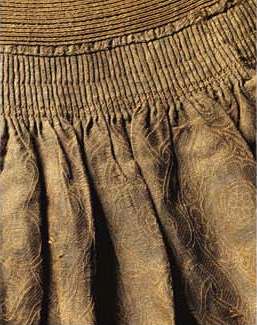
Jumping back, though, I've got some working out to do on the pleating.  Pleating is not something I readily understand in terms of how to construct them.  I know there are different kinds of pleats which sit different ways.

First, a close up of the pleating:
Same source as extant at beginning
I really enjoy this detail shot because I have seen numerous examples from the Persian sphere of Mongol cross-over coats having this silhouette and general construction pattern.

I was talking with Elvira yesterday about garb fantasies and my sticking points.  And there are two with this particular deel construction.

The pleats and the belt.  The belt I'll get to in a minute, but the pleats I want to dive into more.

They way they sit they look like cartridge pleats.  I've laid out cartridge pleats for other members of the household's garb.  I know how to do it, but I have literally no evidence (there's no inside detail shot I can find) that this is, in fact, a type of cartridge pleat.

It's insanely neat and ordered, but without the evidence for cartridge pleating, I have to believe it's probably insanely small, and well organized, gathers.  They appear to be sewn in 3 spots: one to the upper part of the coat, one in the center and then one a bit further down to reinforce the drape.  Kind of like a proto-smocking, I suppose.

However, I really am not sure.  I'll have to experiment, and likely fail, a few times before I work it out.

Now the belt.

That belt is a braided in small, smell braids, then sewn together.  As a belt, it is not part of the actual coat itself, but holds it together between the waist and the hips.  That's a lot of braiding. I don't braid well.  That's a problem.

So, I've got some working out to do, which will require some experimentation.  I would not expect as much about this ongoing experiment that I would about the other project, as it's more clear-cut in when I can start and stop, and what that will look like in terms of progress.

14 August 2016

Continued Research in the Titles Project

I hit a snag with the resource I lifted from yesterday as far as being a truly period (read: pre-1600) resource. Classical Mongolian comes into real life around 1700.  That century is troublesome.

It provides some workable thoughts, but just like Old English, Middle English and Modern English are related, but significantly different, so also is Modern, Classical and Middle Mongolian would suffer many of the same problems.

It's a good launching pad, but I need to find a dictionary and grammatical syntax rules book like Introduction to Classical has.

In an attempt to get things rolling again in a more solid direction, I'm starting with Wikipedia's article on Middle Mongolian as a jumping point.  They list their sources and they're fairly extensive.  While I may find different information from those sources, this is Wikipedia after all, I can get in the dirt in the very least focusing on the language the Mongols of the SCA period actually spoke.

13 August 2016

Quest/Titles Project Update

I had mentioned before how the information listed on the EK Alternative Titles page was a bit lackluster, which inspired me to go on an extended project based on a quest given to me by Her Majesty, Queen Avelina.

Well, I made some major progress, but before I get to that, let me take a step back.

Looping into today's earlier post, I have to rely on newer Mongolian vocabulary and grammar than the time period I focus on.  I've come to accept that I don't yet have the research skills, nor the linguistic know-how to get a truly good insight into what I want for my exact person.  And, since this is turning into something which could go to the common good of the Society, having something workable, if not up to my specific persona, is much better than being in perpetual frustration and doubt.

With that being said, I took a look at the resources that are available for Mongol Naming Practices and got my hands on (thanks to a Household member who's a professional librarian) an out-of-print book that focuses specifically on Mongol Grammar.

It's titled Introduction to Classical (Literary) Mongolian (parenthesis theirs),  It is, in a word, a gold mine that I'm super happy I pursued on a gut instinct.

I just got through the read of the title and took, well, copious notes including vocabulary listings, and the grammatical structures for Mongol nouns, adjectives and adverbs.  I know, I'm weird. I like understanding grammar rules.  It's as close to mathy as I think I could ever get.

Anyhow, I started a quick and dirty list of words I think could be helpful, not only for titles themselves but also general use at a Royal level.  In my own notes, I cite the page I found the word so when I submit everything will be properly documented.

Here's the list, unedited and raw (meaning lacking diacritical markings and only Roman letters):
Qagan -- King
Koebgun -- son/boy
Degu - younger brother
Eke - mother
Bars - tiger
Aqa - elder brother
Qatun - Queen
Cerig - soldier
lama - priest/lama
moritu - rider/horseman
noyan - prince/lord
Qan - minor prince, lord (this would be the title I was asked to find, guys.  STOKED)
ulus - people/nation
tusimel - minister/official
arsalan - lion
abagan - master, sire
juljagan - young, offspring
ocuguken - minor/subordinate
degedu - high, elevated
aldartan said -- celebrities, famous poeple
ama|n - family, household
arga - art, craft, plan; trick
ayag-qa - rank of priest; gelung
baga - small, young
bagsi - teacher/scholar
bars, baras - tiger
elci - envoy, embassador
erkim - supreme, chief, outstanding
jarudasu|n - slave, servant, messenger (messenger is the meaning I'm going for)
keukid - children
nokor - comrade, friend, companion (pl. nokod)
Qan kobegun - prince
qaragulci - guard, shepherd
qaragul - sentinel, guard
tusimel - official, minister
quda - brother-in-law, cousin

I think this is a good base to start from.  I do want to find more resources, aside from Wikipedia the open encyclopedia of sometimes ok information, to bolster the list.  But, it's definitely a strong start.

I'm also going to organize my notes in a way which makes presenting the declensions easier to understand for a non-grammatically inclined person.  The grammar becomes important for naming practices with the heralds, as well as any other awards or designations that may be created or given out.

But, that is where I sit right now with the project.  It feels great to have some progress made and something workable I can present to Her Majesty.

06 June 2016

Quick Update on the Quest

I had made a quick mention about checking the College of Heralds for information on what may already be listed.

It's sorely lacking, which is why I'm taking it on as a larger project.  There's clearly a need for this information and it has all come together.

Other, related, thoughts: I'm ditching the Crimean Khanate idea right now.  I may revisit it once I have more resources at my fingertips.

I've also decided to re-up my digital archives access with the Boston Public Library which gives access to all sorts of journals, including through JSTOR.

I'm also going to start putting out some feelers on other people who've done similar with other cultures to see what they've done with it, as well.

05 June 2016

My Quest

As stated in my previous post, I was given a quest by Her Majesty to seek out period and persona appropriate titles for Mongol personae when I received my Award of Arms.

I am always looking for new ways to expand my knowledge, so I obliged the quest.  It intersects a lot of less-utilized aspects of my interests when it comes to the SCA. I have a big interest in linguistics, especially historical linguistics. Needless to say, this is entirely in a wheelhouse I never thought I'd ever be able to live in while playing, given the focus on material culture in the SCA.

With all that being said, there are several challenges I'm going to face when it comes to getting everything sufficiently equivalent for my tastes.  Below is a basic breakdown of what I know already, the challenges it's going to present and what I'm thinking right off for how I can overcome them.

First challenge:
Our game uses a European, especially a French/English, structure to titles based off of High Middle Ages Feudalism.  There is an influence of the trade guilds, as well, with Masters and Mistresses for highest level artisans and scholars.  They all come together right around the end of period, to my knowledge.  So, 1550s to early 1600s.  I am not an expert, by any means, in the timelines and the rises and falls of titles and social structures in Europe, given my own focus, but that's the understanding I have.

Added into that, the Mongol people were and, to some extent, still are a nomadic people.  Landed gentry, frankly, didn't exist in period that was home-grown.  Social structure was based off of cultural norms and the military structure.  As the SCA has an independent military structure, it would be less informative and absolutely be a shoe-horn to take military terms for non-military positions (i.e. not Knights and Squires).  The last thing I want to do is be controversial to the Chivalry -- making a new problem to solve an old one.

Strategy
I'm going to take a look at the Mongols who did settle, so post-Chinggis and see what I can find for the governmental structure.  The Mongols held, and held sway, in territories and kingdoms long after the conquests which brought about the Golden Age of Mongols.  In particular, I'm going to be looking at a couple different places and times to see what it has to offer:

(1)Persia
Persia offers a lot in terms of finding what I need.  The largest advantage to Persia is that they did have land owners and a more European style (than, say, Eastern or Indian style) court.  There was the Shah and then those who reported to him; there were levels of nobility and, most importantly, there was both a military and an artistic/scholarly culture home grown in Persia and its environs.

Additionally, when the Mongols invaded and overthrew the Persians, they didn't overthrow the government in its entirety.  What they did was they created what can be thought of as one of the first modern style shadow governments.  It's not an exact match to what we've seen in the Modern era, like with Vichy France during the Nazi Occupation (Did I just Godwin my blog?), but it's definitely a shadow government.

The way it worked, from what I've been able to find, is that the Mongols took the existing structure and added themselves into it.  This is shown in the miniatures (look, overlap) in that there are always Persians and Mongols together and in relatively reflective positions.  In my garb breakdown, which I'll be posting later today, I have a good example of what I mean.

So, what you have, in essence, is that the Mongols would have had their own positions and what I seek is if they would also have had their own titles to go with those positions.  If that's the case, then it's a Mongol-specific title system I can lift and adjust grammatically according to gender.

(2)The Timurids
The Timurids are one of the last great gasps of the Mongols as a huge force in Asia.  They had their own empire and then went on the conquer and become the antecedents to the Mughals in India.  Having land, they would have needed to structure themselves in a way in which I could use a mirror to find approximates.  Then, the same pattern applies as with the Persians -- figuring out how to make it grammatically sound through gender and post.

This is largely a guess in terms of it will work, but I know that Tamerlane had a court and his successors also had them.  It's also another way for an Indian persona to attribute the appropriate titles onto themselves, as India is neither a monolith nor even a single state area until modern times.  And, depending on what you're looking at as "India", it is still a three-state region with India, Pakistan (where the Indus River is actually located) and Bangladesh (former East Pakistan).

This would make the strongest arguments, if it proves out, because it's homegrown completely within the evolving Mongol culture throughout period and so doesn't fall victim to biases in the way that the Persians do.

(3)The Chinese
The Yuan dynasty, oh how I love you. You have given me so much inspiration and knowledge.  It's the material culture I know the most about and was the Mongol cultural area I was most familiar with even before I started in the SCA.

In all truthfulness, I don't know as much as I should about the social structures of Chinese court and dynastic life as I should.  I tend to focus more overall in figuring out where someone sits in a portrait for general social standing than I do with figuring out what all the iconography means beyond know "Emperor" or "Scholar".  The civil society in China goes back thousands of years and the Yuan dynasty is a funny period for China in terms of how it sees itself, largely being eschewed for native rule dynasties.

This would be similar to Persia in application in that the terms and titles would be adapted from the home culture.  The main difference is that the Chinese were subjects of the Mongols directly instead of shadowed by Mongol overseers (more or less).  The terms, however, would be in Chinese.  That works to the advantage that there is no grammatical gender in Chinese, nor is there real structure in number and tense.  The difficulty is that we have to use modern pronunciations to Middle Chinese because of a pictographic writing system.  There isn't an actual way to know if what we're using now were the actually pronounced ways of the language back that far.

(4)The Crimean Khanate 
The Crimean Khanate is a largely forgotten, semi-independent successor state to the Golden Horde.  It existed as a tribute to the Ottomans and was founded in the mid-late 15th century.  It dates to well within period and, with direct contact with the Ottomans as a tributary, would have had ample information if I can find it.

There are several problems with the Crimean Khanate that can cause issue.  First, its position was precarious.  Sandwiched between the Russian Empire and the Ottoman Empire, it was hot territory for the Russians to take over, which they eventually did in 1774 according to the linked article.  They existed as a trading outpost on, as you can guess, the Crimean peninsula and its environs.

interesting historical tidbit -- the reason why the area is primarily Russian and not primarily Turkic today is because the Soviets expelled the Turkic peoples to the PR Kazakhstan and then russified the area.  This resettlement makes the area Russian ethnically and is a bit of an antecedent to some of the problems that arouse a couple years ago.  See? History is still relevant, even to contemporary events!

Anyway, my main issue is I know basically nothing about the Crimean Khanate, aside from that it existed, they traded with the Ottomans and they were not liked by the Russians who wanted the warm water port.  It would require a ton of research and, I think, most of the information would be on the wars between the Ottomans and Russians and/or the Crimean Wars much, much later.  It looks, on face, as a historical dead zone.

Second Challenge:
Even if the Mongols were to have been a landed culture on their own, they were not a literate culture until the smashed into other folks by conquering them.  There simply is no way to have one, mass title database for everything that could possibly have been as oral traditions change with changes in cultures.  Think about how Grimm fairy tales changed in records, even when being written down sporadically through the times they were being told in medieval and early-modern Germany.

Lacking a real written record is, of course, a challenge I work around all the time.  I tend to rely on China and Persia, since the biases of the writers are well known.

Strategy
I'm going to continue to use the methods I'm already using. It will be trickier since, instead of using visual reference it will need to be written, but a process part of anything I submit as to how I worked around biases should cover those shortfalls.  It's not perfect, but it can work.

Third Challenge:
I don't know that much about Middle Mongol grammar.  This is a huge area that will require a good amount of study.  Once Mongolian was written down, it was written using Chinese character, Sogdian-Uyghir script and Persian-adapted Arabic.  Later, Mongolian used Cyrillic letters with additional home-grown lettering to capture the phonetics of the language.

Strategy
I've just got to learn the language.  I've already got a request out to Jacquemine van Bel who is not only a great and close pre-SCA friend of mine but a legitimate librarian with the paperwork to prove it.  We're already turning up helpful resources for me to use and, being in the higher education utopia of New England, we should be able to get some good access as she works for a college library.

Upcoming, I'll go more into what I've done so far to reach to these conclusions instead of do something smaller like just run to the College of Heralds site (spoiler: not as helpful as I'd have liked).

26 January 2015

Long Awaited Update

I fell off the blogging bandwagon for a while.  It's more of my picking up and putting down research and less of progressing research with no update.  My mundane life has taken a turn for the busy and, as a result, my research has suffered a bit.

That doesn't mean I've not doing anything.

I took a break from the class breakdown in Persian art and moved over to the Chinese manuscripts.  I had been finding that the non-acculturated Mongol's in Persia is difficult to find in the resources I've been able to recover from the public domain, as I'm a hobbyist and not a traditional academic.  My BPL card has also expired unexpectedly, which causes another bump in the road.

In China, though, it's easier for me to discern what I'm looking at.  Generally, I'm more familiar with the artistic styles of the Chinese through out time and have a greater understanding of the social structures and cultural nuance from my days before the SCA.

They paintings are more abundant because of cultural frictions intermixed with a stubborn lack of intercultural exchange in the upper echelons of Chinese Imperial society during the Yuan period.  Instead of working in tandem, like in Persia, the Chinese were ruled by the Mongols who did not "go local" but did learn the philosophies.

I've been able to become confident in nailing down that the fanciness of any given figure's fabric pattern/weave.  It does answer a fundamental question I came into this project seeking to answer.  Seeing that it is  consistent between China and Persia suggests that it was a Mongol social status rank marker and it is less likely that it is a convention of the respective cultures to derank certain positions over others.

At this point, I need to revisit the common themes and motifs documented in academic resources so I can begin to up my personal game futher.

28 February 2014

On the Class Depiction Thesis

My early research into this theory is getting off to a little bit of a slow start, admittedly.  It's turned into a bigger undertaking than I was imagining.

As with any culture, I'm recoiling to treat it as a monolith.  Having seen the misconceptions of a monolithic and unchanging Mongolian culture permeate not only history texts but also SCA reenacting, I want to make sure I have a good understanding of the basic precepts, while also not getting into the real intricacies of a culture which isn't my entire focus.

As any hobbyist, I'm prone to fall down rabbit holes of research, as well, taking me off course.  I'm deeply and sincerely interested in all of the aspects of what I'm looking at, but I need to keep my focus so I'm not chasing ducks and losing where I want to go and what I really want to accomplish with this project.

To that end, I found a great article from my JSTOR searching which has given a great baseline for how Persians depicted social class during the transitional period into the Il-Khanate.

Not only does the author give the physical positioning and its relation to understood implications of social class, but also he describes the clothing (with the miniatures' images) which also help in decoding the ways in which differing classes dressed.  He does this with both Persians and Mongols within the text.

I plan to use this resource to compare with my own collection of Mongols in miniatures I've cultivated on Pinterest.

I'm hoping, using the same journal's archives, to find a more recent source which does the same breakdowns.  While fantastic, the source was published in 1959 and I'd like to find out if theories and practices for decoding miniatures has changed over the ensuing decades.

23 February 2014

Genesis

This blog is dedicated to my research exploits related to the Society for Creative Anachronism.  In Society, I go by Erdene Qadajin, a resident of the East Kingdom residing in the Shire of Quintavia but primarily playing in the Barony of Stonemarche.  I currently have the persona of a 14th to 16th century Mongol from deep in the Asian steppe, but no particular location as of yet.

My latest project came about from a couple different areas.  First, I am admittedly a junky for being authentic.  I like to know what I'm creating and putting on my body is as accurate as can be or can be afforded.  I like to know that that I'm doing and how I'm doing it is a best can be represented in the culture I'm displaying.  It's especially compounded by being one of a small number of the populace with a primary of persona from the Mongol tribes.

Second, I haven't been able to find very many specific resources in the SCA.  Many are introductory and, while that is useful for someone who's "dipping their toes" into making Mongol garb, it becomes less useful as I've tried to develop my persona.  There is extensive research and exampling on European cultures, especially Western Europe and there's a fair amount of research in Islamic cultures (Persian, Mamluk, Abbasyd, Ottoman) with its recent surge in popularity.  However, the resources on an important European contact culture like the Mongols are difficult, if not impossible to find without academic library and database access.

So, I turned to Pinterest for initial inspiration.  Pinterest has a wide array of visual information on Mongols in period (pre-1600) -- from extant examples to Chinese and Persian manuscripts.

As I have assembled my army of resources I noticed something peculiar:
in depictions of Mongols, they are typically shown in plain clothing.  A single color deel, sometimes even lacking the second (short sleeved) deel layer.
in extant Mongol clothing from grave finds, the clothing is rich in color and pattern, often blindingly so even after centuries of degradation of fabric.

My goal in my research is two-fold and broken into large "stages".

Goal one is to figure out why the miniatures depict the Mongols in the way that they do.  My primary focuses are on Persian and Chinese manuscripts -- in particular paintings -- contemporary to the Mongol invasions and occupations of those cultures.

My current theories, which are based on general guidelines, are three-fold.
First, did the artist have enough space to make the patterns associated with extant finds, in the case of miniatures
Second, did the Mongols have Court versus "Day Wear" clothing depending on the task at hand, or is this a symbolism of an emergent Mongol class system
Third, is this propaganda on the part of these cultures to prove their superiority through the arts they created.

My plan is to first start with Persian miniatures, as my personal connections within the SCA are stronger for finding examples.  I need to learn how the Persians depicted social classes and foreigners within their miniatures, and how those models are transplanted onto the pictured Mongols.

If necessary and possible, I will then take that information and cross-compare the miniatures with size dimension to determine if space may also be a factor in details.

Second, I will repeat the process through learning about the Chinese style and applying the same precepts and principles and that culture.

Third, I will take those two cultures and what I've learned and apply it to the extants and what can be learned about the social circumstances of those who wore the garments.

Finally, is an analysis for what this means in terms of SCA persona building and Mongol re-enactors for the focus time period in general.