There's a word-on-the-street maxium that says some of your best ideas and thoughts happen when you're least expecting them -- in the shower, right before falling asleep, when driving on the open road and the like. Any time when your mind can bring those twisty-turny thoughts more to the front and start to do some untying and solving.
I had one of those moments last night while drifting to sleep related to research.
With the new direction, I've been feeling a bit adrift and so have lost a bit of my researching mojo. I am still utterly fascinated by the Yuan dynasty era Mongols, so I'm not feeling a persona change or anything drastic. It's more that I haven't been able to dedicate myself to making a game plan on incorporating new information and approaches.
It's made it especially difficult to read the newer research information I've compiled because I've been struggling with where it "fits" in what I'm looking at. It feel both relevant and irrelevant to what I'm doing, and the ambiguity is sapping my ability to focus when I have the chance. The little voice in my back of my head says "and this helps you how?" and I'm having a time understanding not only the "why" of the question but actually answering it.
Last night, I think I solved it, but it requires some work to make a frame on which to hang everything.
The new direction is more than just looking at stuff out of the ground. I've oversimplified it because it's easier to talk about it that way, before refining the idea.
The new direction is a holistic look at the material and other cultural aspects of the idea of my persona. So, more than "what all did you wear?" it's also "what all did you eat? what would your social standing be? how did you get there? what's your religious background? what languages would you speak?" and other related questions.
So, instead of a deep dive into a narrow subject, it's a deep dive into a narrow time.
What came to me last night was a pretty simple, though somewhat profound, idea. Literally organizing Erdene's life into departments.
Just like a real department store, they'll bleed into each other like how activewear and formalwear are separate, but the connect through casual clothing.
What I've come up with so far is:
Food: What did he eat? With whom did he eat it? How often could he expect to eat? Would it have changed moving from the frontier to the heart of the Empire?
Faith: What would his religion probably have been? What other religions would he had been exposed to? How did they come together? Who celebrated what faiths? Would he have had a different faith than his neighbors? parents? siblings? What were the prevailing philosophies of the time?
Social: What social biases did he have? Would he have been considered a racist by modern standards? How would growing up on the Silk Routs have changed his view of outsiders? Would he be in an ethnically mixed environment, or would it have been homogenous? Who would he consider 'his people'? How would he identify his in-groups and his out-groups?
Government: How would he understand his government? Would the government be supportive or oppressive to his religious and other markers? What would have been his most probably role in government? Who're the major players in the government? What does the bureaucracy look like (since this is China)? Who is eligible to be a Civil Servant?
Material: What did he own? How would he have bought or gotten it? What are his clothes made of? How are they constructed? What does he live in? Is it portable? Is he still nomadic or has he settled?
Again, all of these topics and questions overlap each other and inform each other. Some can be answered by traditional archaeology, others will need historical study. But, by having the archaeological study background first, I can use that to do gut-checking on the historian's interpretation of social structures and customs.
Showing posts with label planning. Show all posts
Showing posts with label planning. Show all posts
04 March 2017

28 August 2016
Something Mongol and NOT grammar or titles?! WHAT CRAZY IS THIS
I've put a lot of time into the Grammar and Titles project recently, which has been reflected here, but I also have been looking at my next garb project for generally usable garb -- so not a special challenge or theme.
I'm multi-talented, or maybe ADD, like that. I like to think multi-talented, but sometimes I get bored and my interests wander off to something which isn't my main focus for a while.
I want to make something inspired by this:
Now, you might be thinking "this doesn't look that much different than what you usually do" and you'd be both right and a bit off base.
First, the general construction of Mongol deels hasn't really changed much over the passing centuries. I believe I've talked to the basic construction before, but in case I haven't, the general pattern I have memorized is here. I do some modifications, like I will take out the panel extensions because of the fit I usually do, which is loose in the lower half, but you can see the basics of it in any of the pictures of me I've posted up here for head-to-toe analysis and the like.
Now, unsurprising to most people who study it, but history is messy. People then, like now, don't fall into these discrete and easy groupings, and with that, comes variations across.
In China, the strong influence of the Chinese ethnic groups means that I generally haven't seen the deels like the above. They tend to be less fitted, longer and more simple in design and construction, relying on the strength and prominence of the fabric to do the talking.
The example above, is from the Persian sphere of influence. What that means is that the Mongols changed their deel a bit, the longer they were there, until it becomes the cross-over coat that the early Mughals wore, at least until Period ends in the early 17th century.
It looks like this:
Jumping back, though, I've got some working out to do on the pleating. Pleating is not something I readily understand in terms of how to construct them. I know there are different kinds of pleats which sit different ways.
First, a close up of the pleating:
I really enjoy this detail shot because I have seen numerous examples from the Persian sphere of Mongol cross-over coats having this silhouette and general construction pattern.
I was talking with Elvira yesterday about garb fantasies and my sticking points. And there are two with this particular deel construction.
The pleats and the belt. The belt I'll get to in a minute, but the pleats I want to dive into more.
They way they sit they look like cartridge pleats. I've laid out cartridge pleats for other members of the household's garb. I know how to do it, but I have literally no evidence (there's no inside detail shot I can find) that this is, in fact, a type of cartridge pleat.
It's insanely neat and ordered, but without the evidence for cartridge pleating, I have to believe it's probably insanely small, and well organized, gathers. They appear to be sewn in 3 spots: one to the upper part of the coat, one in the center and then one a bit further down to reinforce the drape. Kind of like a proto-smocking, I suppose.
However, I really am not sure. I'll have to experiment, and likely fail, a few times before I work it out.
Now the belt.
That belt is a braided in small, smell braids, then sewn together. As a belt, it is not part of the actual coat itself, but holds it together between the waist and the hips. That's a lot of braiding. I don't braid well. That's a problem.
So, I've got some working out to do, which will require some experimentation. I would not expect as much about this ongoing experiment that I would about the other project, as it's more clear-cut in when I can start and stop, and what that will look like in terms of progress.
I'm multi-talented, or maybe ADD, like that. I like to think multi-talented, but sometimes I get bored and my interests wander off to something which isn't my main focus for a while.
I want to make something inspired by this:
 |
| source |
First, the general construction of Mongol deels hasn't really changed much over the passing centuries. I believe I've talked to the basic construction before, but in case I haven't, the general pattern I have memorized is here. I do some modifications, like I will take out the panel extensions because of the fit I usually do, which is loose in the lower half, but you can see the basics of it in any of the pictures of me I've posted up here for head-to-toe analysis and the like.
Now, unsurprising to most people who study it, but history is messy. People then, like now, don't fall into these discrete and easy groupings, and with that, comes variations across.
In China, the strong influence of the Chinese ethnic groups means that I generally haven't seen the deels like the above. They tend to be less fitted, longer and more simple in design and construction, relying on the strength and prominence of the fabric to do the talking.
The example above, is from the Persian sphere of influence. What that means is that the Mongols changed their deel a bit, the longer they were there, until it becomes the cross-over coat that the early Mughals wore, at least until Period ends in the early 17th century.
It looks like this:
 |
| source |
First, a close up of the pleating:
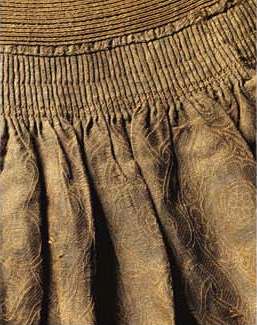 |
| Same source as extant at beginning |
I was talking with Elvira yesterday about garb fantasies and my sticking points. And there are two with this particular deel construction.
The pleats and the belt. The belt I'll get to in a minute, but the pleats I want to dive into more.
They way they sit they look like cartridge pleats. I've laid out cartridge pleats for other members of the household's garb. I know how to do it, but I have literally no evidence (there's no inside detail shot I can find) that this is, in fact, a type of cartridge pleat.
It's insanely neat and ordered, but without the evidence for cartridge pleating, I have to believe it's probably insanely small, and well organized, gathers. They appear to be sewn in 3 spots: one to the upper part of the coat, one in the center and then one a bit further down to reinforce the drape. Kind of like a proto-smocking, I suppose.
However, I really am not sure. I'll have to experiment, and likely fail, a few times before I work it out.
Now the belt.
That belt is a braided in small, smell braids, then sewn together. As a belt, it is not part of the actual coat itself, but holds it together between the waist and the hips. That's a lot of braiding. I don't braid well. That's a problem.
So, I've got some working out to do, which will require some experimentation. I would not expect as much about this ongoing experiment that I would about the other project, as it's more clear-cut in when I can start and stop, and what that will look like in terms of progress.
05 June 2016
My Quest
As stated in my previous post, I was given a quest by Her Majesty to seek out period and persona appropriate titles for Mongol personae when I received my Award of Arms.
I am always looking for new ways to expand my knowledge, so I obliged the quest. It intersects a lot of less-utilized aspects of my interests when it comes to the SCA. I have a big interest in linguistics, especially historical linguistics. Needless to say, this is entirely in a wheelhouse I never thought I'd ever be able to live in while playing, given the focus on material culture in the SCA.
With all that being said, there are several challenges I'm going to face when it comes to getting everything sufficiently equivalent for my tastes. Below is a basic breakdown of what I know already, the challenges it's going to present and what I'm thinking right off for how I can overcome them.
First challenge:
Our game uses a European, especially a French/English, structure to titles based off of High Middle Ages Feudalism. There is an influence of the trade guilds, as well, with Masters and Mistresses for highest level artisans and scholars. They all come together right around the end of period, to my knowledge. So, 1550s to early 1600s. I am not an expert, by any means, in the timelines and the rises and falls of titles and social structures in Europe, given my own focus, but that's the understanding I have.
Added into that, the Mongol people were and, to some extent, still are a nomadic people. Landed gentry, frankly, didn't exist in period that was home-grown. Social structure was based off of cultural norms and the military structure. As the SCA has an independent military structure, it would be less informative and absolutely be a shoe-horn to take military terms for non-military positions (i.e. not Knights and Squires). The last thing I want to do is be controversial to the Chivalry -- making a new problem to solve an old one.
Strategy
I'm going to take a look at the Mongols who did settle, so post-Chinggis and see what I can find for the governmental structure. The Mongols held, and held sway, in territories and kingdoms long after the conquests which brought about the Golden Age of Mongols. In particular, I'm going to be looking at a couple different places and times to see what it has to offer:
(1)Persia
Persia offers a lot in terms of finding what I need. The largest advantage to Persia is that they did have land owners and a more European style (than, say, Eastern or Indian style) court. There was the Shah and then those who reported to him; there were levels of nobility and, most importantly, there was both a military and an artistic/scholarly culture home grown in Persia and its environs.
Additionally, when the Mongols invaded and overthrew the Persians, they didn't overthrow the government in its entirety. What they did was they created what can be thought of as one of the first modern style shadow governments. It's not an exact match to what we've seen in the Modern era, like with Vichy France during the Nazi Occupation (Did I just Godwin my blog?), but it's definitely a shadow government.
The way it worked, from what I've been able to find, is that the Mongols took the existing structure and added themselves into it. This is shown in the miniatures (look, overlap) in that there are always Persians and Mongols together and in relatively reflective positions. In my garb breakdown, which I'll be posting later today, I have a good example of what I mean.
So, what you have, in essence, is that the Mongols would have had their own positions and what I seek is if they would also have had their own titles to go with those positions. If that's the case, then it's a Mongol-specific title system I can lift and adjust grammatically according to gender.
(2)The Timurids
The Timurids are one of the last great gasps of the Mongols as a huge force in Asia. They had their own empire and then went on the conquer and become the antecedents to the Mughals in India. Having land, they would have needed to structure themselves in a way in which I could use a mirror to find approximates. Then, the same pattern applies as with the Persians -- figuring out how to make it grammatically sound through gender and post.
This is largely a guess in terms of it will work, but I know that Tamerlane had a court and his successors also had them. It's also another way for an Indian persona to attribute the appropriate titles onto themselves, as India is neither a monolith nor even a single state area until modern times. And, depending on what you're looking at as "India", it is still a three-state region with India, Pakistan (where the Indus River is actually located) and Bangladesh (former East Pakistan).
This would make the strongest arguments, if it proves out, because it's homegrown completely within the evolving Mongol culture throughout period and so doesn't fall victim to biases in the way that the Persians do.
(3)The Chinese
The Yuan dynasty, oh how I love you. You have given me so much inspiration and knowledge. It's the material culture I know the most about and was the Mongol cultural area I was most familiar with even before I started in the SCA.
In all truthfulness, I don't know as much as I should about the social structures of Chinese court and dynastic life as I should. I tend to focus more overall in figuring out where someone sits in a portrait for general social standing than I do with figuring out what all the iconography means beyond know "Emperor" or "Scholar". The civil society in China goes back thousands of years and the Yuan dynasty is a funny period for China in terms of how it sees itself, largely being eschewed for native rule dynasties.
This would be similar to Persia in application in that the terms and titles would be adapted from the home culture. The main difference is that the Chinese were subjects of the Mongols directly instead of shadowed by Mongol overseers (more or less). The terms, however, would be in Chinese. That works to the advantage that there is no grammatical gender in Chinese, nor is there real structure in number and tense. The difficulty is that we have to use modern pronunciations to Middle Chinese because of a pictographic writing system. There isn't an actual way to know if what we're using now were the actually pronounced ways of the language back that far.
(4)The Crimean Khanate
The Crimean Khanate is a largely forgotten, semi-independent successor state to the Golden Horde. It existed as a tribute to the Ottomans and was founded in the mid-late 15th century. It dates to well within period and, with direct contact with the Ottomans as a tributary, would have had ample information if I can find it.
There are several problems with the Crimean Khanate that can cause issue. First, its position was precarious. Sandwiched between the Russian Empire and the Ottoman Empire, it was hot territory for the Russians to take over, which they eventually did in 1774 according to the linked article. They existed as a trading outpost on, as you can guess, the Crimean peninsula and its environs.
interesting historical tidbit -- the reason why the area is primarily Russian and not primarily Turkic today is because the Soviets expelled the Turkic peoples to the PR Kazakhstan and then russified the area. This resettlement makes the area Russian ethnically and is a bit of an antecedent to some of the problems that arouse a couple years ago. See? History is still relevant, even to contemporary events!
Anyway, my main issue is I know basically nothing about the Crimean Khanate, aside from that it existed, they traded with the Ottomans and they were not liked by the Russians who wanted the warm water port. It would require a ton of research and, I think, most of the information would be on the wars between the Ottomans and Russians and/or the Crimean Wars much, much later. It looks, on face, as a historical dead zone.
Second Challenge:
Even if the Mongols were to have been a landed culture on their own, they were not a literate culture until the smashed into other folks by conquering them. There simply is no way to have one, mass title database for everything that could possibly have been as oral traditions change with changes in cultures. Think about how Grimm fairy tales changed in records, even when being written down sporadically through the times they were being told in medieval and early-modern Germany.
Lacking a real written record is, of course, a challenge I work around all the time. I tend to rely on China and Persia, since the biases of the writers are well known.
Strategy
I'm going to continue to use the methods I'm already using. It will be trickier since, instead of using visual reference it will need to be written, but a process part of anything I submit as to how I worked around biases should cover those shortfalls. It's not perfect, but it can work.
Third Challenge:
I don't know that much about Middle Mongol grammar. This is a huge area that will require a good amount of study. Once Mongolian was written down, it was written using Chinese character, Sogdian-Uyghir script and Persian-adapted Arabic. Later, Mongolian used Cyrillic letters with additional home-grown lettering to capture the phonetics of the language.
Strategy
I've just got to learn the language. I've already got a request out to Jacquemine van Bel who is not only a great and close pre-SCA friend of mine but a legitimate librarian with the paperwork to prove it. We're already turning up helpful resources for me to use and, being in the higher education utopia of New England, we should be able to get some good access as she works for a college library.
Upcoming, I'll go more into what I've done so far to reach to these conclusions instead of do something smaller like just run to the College of Heralds site (spoiler: not as helpful as I'd have liked).
I am always looking for new ways to expand my knowledge, so I obliged the quest. It intersects a lot of less-utilized aspects of my interests when it comes to the SCA. I have a big interest in linguistics, especially historical linguistics. Needless to say, this is entirely in a wheelhouse I never thought I'd ever be able to live in while playing, given the focus on material culture in the SCA.
With all that being said, there are several challenges I'm going to face when it comes to getting everything sufficiently equivalent for my tastes. Below is a basic breakdown of what I know already, the challenges it's going to present and what I'm thinking right off for how I can overcome them.
First challenge:
Our game uses a European, especially a French/English, structure to titles based off of High Middle Ages Feudalism. There is an influence of the trade guilds, as well, with Masters and Mistresses for highest level artisans and scholars. They all come together right around the end of period, to my knowledge. So, 1550s to early 1600s. I am not an expert, by any means, in the timelines and the rises and falls of titles and social structures in Europe, given my own focus, but that's the understanding I have.
Added into that, the Mongol people were and, to some extent, still are a nomadic people. Landed gentry, frankly, didn't exist in period that was home-grown. Social structure was based off of cultural norms and the military structure. As the SCA has an independent military structure, it would be less informative and absolutely be a shoe-horn to take military terms for non-military positions (i.e. not Knights and Squires). The last thing I want to do is be controversial to the Chivalry -- making a new problem to solve an old one.
Strategy
I'm going to take a look at the Mongols who did settle, so post-Chinggis and see what I can find for the governmental structure. The Mongols held, and held sway, in territories and kingdoms long after the conquests which brought about the Golden Age of Mongols. In particular, I'm going to be looking at a couple different places and times to see what it has to offer:
(1)Persia
Persia offers a lot in terms of finding what I need. The largest advantage to Persia is that they did have land owners and a more European style (than, say, Eastern or Indian style) court. There was the Shah and then those who reported to him; there were levels of nobility and, most importantly, there was both a military and an artistic/scholarly culture home grown in Persia and its environs.
Additionally, when the Mongols invaded and overthrew the Persians, they didn't overthrow the government in its entirety. What they did was they created what can be thought of as one of the first modern style shadow governments. It's not an exact match to what we've seen in the Modern era, like with Vichy France during the Nazi Occupation (Did I just Godwin my blog?), but it's definitely a shadow government.
The way it worked, from what I've been able to find, is that the Mongols took the existing structure and added themselves into it. This is shown in the miniatures (look, overlap) in that there are always Persians and Mongols together and in relatively reflective positions. In my garb breakdown, which I'll be posting later today, I have a good example of what I mean.
So, what you have, in essence, is that the Mongols would have had their own positions and what I seek is if they would also have had their own titles to go with those positions. If that's the case, then it's a Mongol-specific title system I can lift and adjust grammatically according to gender.
(2)The Timurids
The Timurids are one of the last great gasps of the Mongols as a huge force in Asia. They had their own empire and then went on the conquer and become the antecedents to the Mughals in India. Having land, they would have needed to structure themselves in a way in which I could use a mirror to find approximates. Then, the same pattern applies as with the Persians -- figuring out how to make it grammatically sound through gender and post.
This is largely a guess in terms of it will work, but I know that Tamerlane had a court and his successors also had them. It's also another way for an Indian persona to attribute the appropriate titles onto themselves, as India is neither a monolith nor even a single state area until modern times. And, depending on what you're looking at as "India", it is still a three-state region with India, Pakistan (where the Indus River is actually located) and Bangladesh (former East Pakistan).
This would make the strongest arguments, if it proves out, because it's homegrown completely within the evolving Mongol culture throughout period and so doesn't fall victim to biases in the way that the Persians do.
(3)The Chinese
The Yuan dynasty, oh how I love you. You have given me so much inspiration and knowledge. It's the material culture I know the most about and was the Mongol cultural area I was most familiar with even before I started in the SCA.
In all truthfulness, I don't know as much as I should about the social structures of Chinese court and dynastic life as I should. I tend to focus more overall in figuring out where someone sits in a portrait for general social standing than I do with figuring out what all the iconography means beyond know "Emperor" or "Scholar". The civil society in China goes back thousands of years and the Yuan dynasty is a funny period for China in terms of how it sees itself, largely being eschewed for native rule dynasties.
This would be similar to Persia in application in that the terms and titles would be adapted from the home culture. The main difference is that the Chinese were subjects of the Mongols directly instead of shadowed by Mongol overseers (more or less). The terms, however, would be in Chinese. That works to the advantage that there is no grammatical gender in Chinese, nor is there real structure in number and tense. The difficulty is that we have to use modern pronunciations to Middle Chinese because of a pictographic writing system. There isn't an actual way to know if what we're using now were the actually pronounced ways of the language back that far.
(4)The Crimean Khanate
The Crimean Khanate is a largely forgotten, semi-independent successor state to the Golden Horde. It existed as a tribute to the Ottomans and was founded in the mid-late 15th century. It dates to well within period and, with direct contact with the Ottomans as a tributary, would have had ample information if I can find it.
There are several problems with the Crimean Khanate that can cause issue. First, its position was precarious. Sandwiched between the Russian Empire and the Ottoman Empire, it was hot territory for the Russians to take over, which they eventually did in 1774 according to the linked article. They existed as a trading outpost on, as you can guess, the Crimean peninsula and its environs.
interesting historical tidbit -- the reason why the area is primarily Russian and not primarily Turkic today is because the Soviets expelled the Turkic peoples to the PR Kazakhstan and then russified the area. This resettlement makes the area Russian ethnically and is a bit of an antecedent to some of the problems that arouse a couple years ago. See? History is still relevant, even to contemporary events!
Anyway, my main issue is I know basically nothing about the Crimean Khanate, aside from that it existed, they traded with the Ottomans and they were not liked by the Russians who wanted the warm water port. It would require a ton of research and, I think, most of the information would be on the wars between the Ottomans and Russians and/or the Crimean Wars much, much later. It looks, on face, as a historical dead zone.
Second Challenge:
Even if the Mongols were to have been a landed culture on their own, they were not a literate culture until the smashed into other folks by conquering them. There simply is no way to have one, mass title database for everything that could possibly have been as oral traditions change with changes in cultures. Think about how Grimm fairy tales changed in records, even when being written down sporadically through the times they were being told in medieval and early-modern Germany.
Lacking a real written record is, of course, a challenge I work around all the time. I tend to rely on China and Persia, since the biases of the writers are well known.
Strategy
I'm going to continue to use the methods I'm already using. It will be trickier since, instead of using visual reference it will need to be written, but a process part of anything I submit as to how I worked around biases should cover those shortfalls. It's not perfect, but it can work.
Third Challenge:
I don't know that much about Middle Mongol grammar. This is a huge area that will require a good amount of study. Once Mongolian was written down, it was written using Chinese character, Sogdian-Uyghir script and Persian-adapted Arabic. Later, Mongolian used Cyrillic letters with additional home-grown lettering to capture the phonetics of the language.
Strategy
I've just got to learn the language. I've already got a request out to Jacquemine van Bel who is not only a great and close pre-SCA friend of mine but a legitimate librarian with the paperwork to prove it. We're already turning up helpful resources for me to use and, being in the higher education utopia of New England, we should be able to get some good access as she works for a college library.
Upcoming, I'll go more into what I've done so far to reach to these conclusions instead of do something smaller like just run to the College of Heralds site (spoiler: not as helpful as I'd have liked).
28 February 2014
On the Class Depiction Thesis
My early research into this theory is getting off to a little bit of a slow start, admittedly. It's turned into a bigger undertaking than I was imagining.
As with any culture, I'm recoiling to treat it as a monolith. Having seen the misconceptions of a monolithic and unchanging Mongolian culture permeate not only history texts but also SCA reenacting, I want to make sure I have a good understanding of the basic precepts, while also not getting into the real intricacies of a culture which isn't my entire focus.
As any hobbyist, I'm prone to fall down rabbit holes of research, as well, taking me off course. I'm deeply and sincerely interested in all of the aspects of what I'm looking at, but I need to keep my focus so I'm not chasing ducks and losing where I want to go and what I really want to accomplish with this project.
To that end, I found a great article from my JSTOR searching which has given a great baseline for how Persians depicted social class during the transitional period into the Il-Khanate.
Not only does the author give the physical positioning and its relation to understood implications of social class, but also he describes the clothing (with the miniatures' images) which also help in decoding the ways in which differing classes dressed. He does this with both Persians and Mongols within the text.
I plan to use this resource to compare with my own collection of Mongols in miniatures I've cultivated on Pinterest.
I'm hoping, using the same journal's archives, to find a more recent source which does the same breakdowns. While fantastic, the source was published in 1959 and I'd like to find out if theories and practices for decoding miniatures has changed over the ensuing decades.
As with any culture, I'm recoiling to treat it as a monolith. Having seen the misconceptions of a monolithic and unchanging Mongolian culture permeate not only history texts but also SCA reenacting, I want to make sure I have a good understanding of the basic precepts, while also not getting into the real intricacies of a culture which isn't my entire focus.
As any hobbyist, I'm prone to fall down rabbit holes of research, as well, taking me off course. I'm deeply and sincerely interested in all of the aspects of what I'm looking at, but I need to keep my focus so I'm not chasing ducks and losing where I want to go and what I really want to accomplish with this project.
To that end, I found a great article from my JSTOR searching which has given a great baseline for how Persians depicted social class during the transitional period into the Il-Khanate.
Not only does the author give the physical positioning and its relation to understood implications of social class, but also he describes the clothing (with the miniatures' images) which also help in decoding the ways in which differing classes dressed. He does this with both Persians and Mongols within the text.
I plan to use this resource to compare with my own collection of Mongols in miniatures I've cultivated on Pinterest.
I'm hoping, using the same journal's archives, to find a more recent source which does the same breakdowns. While fantastic, the source was published in 1959 and I'd like to find out if theories and practices for decoding miniatures has changed over the ensuing decades.
Subscribe to:
Posts (Atom)