There's a word-on-the-street maxium that says some of your best ideas and thoughts happen when you're least expecting them -- in the shower, right before falling asleep, when driving on the open road and the like. Any time when your mind can bring those twisty-turny thoughts more to the front and start to do some untying and solving.
I had one of those moments last night while drifting to sleep related to research.
With the new direction, I've been feeling a bit adrift and so have lost a bit of my researching mojo. I am still utterly fascinated by the Yuan dynasty era Mongols, so I'm not feeling a persona change or anything drastic. It's more that I haven't been able to dedicate myself to making a game plan on incorporating new information and approaches.
It's made it especially difficult to read the newer research information I've compiled because I've been struggling with where it "fits" in what I'm looking at. It feel both relevant and irrelevant to what I'm doing, and the ambiguity is sapping my ability to focus when I have the chance. The little voice in my back of my head says "and this helps you how?" and I'm having a time understanding not only the "why" of the question but actually answering it.
Last night, I think I solved it, but it requires some work to make a frame on which to hang everything.
The new direction is more than just looking at stuff out of the ground. I've oversimplified it because it's easier to talk about it that way, before refining the idea.
The new direction is a holistic look at the material and other cultural aspects of the idea of my persona. So, more than "what all did you wear?" it's also "what all did you eat? what would your social standing be? how did you get there? what's your religious background? what languages would you speak?" and other related questions.
So, instead of a deep dive into a narrow subject, it's a deep dive into a narrow time.
What came to me last night was a pretty simple, though somewhat profound, idea. Literally organizing Erdene's life into departments.
Just like a real department store, they'll bleed into each other like how activewear and formalwear are separate, but the connect through casual clothing.
What I've come up with so far is:
Food: What did he eat? With whom did he eat it? How often could he expect to eat? Would it have changed moving from the frontier to the heart of the Empire?
Faith: What would his religion probably have been? What other religions would he had been exposed to? How did they come together? Who celebrated what faiths? Would he have had a different faith than his neighbors? parents? siblings? What were the prevailing philosophies of the time?
Social: What social biases did he have? Would he have been considered a racist by modern standards? How would growing up on the Silk Routs have changed his view of outsiders? Would he be in an ethnically mixed environment, or would it have been homogenous? Who would he consider 'his people'? How would he identify his in-groups and his out-groups?
Government: How would he understand his government? Would the government be supportive or oppressive to his religious and other markers? What would have been his most probably role in government? Who're the major players in the government? What does the bureaucracy look like (since this is China)? Who is eligible to be a Civil Servant?
Material: What did he own? How would he have bought or gotten it? What are his clothes made of? How are they constructed? What does he live in? Is it portable? Is he still nomadic or has he settled?
Again, all of these topics and questions overlap each other and inform each other. Some can be answered by traditional archaeology, others will need historical study. But, by having the archaeological study background first, I can use that to do gut-checking on the historian's interpretation of social structures and customs.
04 March 2017

19 February 2017
Temporary Pause in Updates
I know it's only been a couple weeks, but I wanted to take the opportunity to update you all on the goings on here.
I'm pursuing a new research direction for the Clothing Project and, as a result, I'm in the process of collecting resources and information for the new angle.
I'm shifting, at least for right now, from looking at art, to looking at what's been pulled out from the ground in archaeological digs. The best way to know who wore what, is to pull it from a grave complex.
As is my typical, I am starting with China's Yuan dynasty. It's more in my persona's realm, and I've always been more naturally drawn to China. Persian is hugely interesting and I'm not looking to drop it, don't get me wrong, but my love of all things Sinology is deep and abiding.
This does mean I will need to take a pause while I read and digest what others have found, and their conclusions. I like to make sure I have a good baseline before I walk off on my own, drawing conclusions and making hypotheses.
I am also in the very beginning stages of forming a class on basic construction of Mongol deel. The earliest debut would be at Great Northeastern War this summer. I'd use examples from my own failed garb closet to build on the case, and use a type of visual example not seen frequently: the own teacher's process in learning.
More on that, most likely, before anything else.
Thank you for your patience!
29 January 2017
Excitement
I took a big step this weekend.
This weekend was the Market Day at Birka event here in the East. It's the largest event that the Barony of Stonemache (New Hampshire) does and I make it a point to get there every year. It always a source of inspiration for me when I see what other people do. The A&S display inspires me to get my hands into things more, there are always a few peerages earned (because it is work and dedication to get there), the fashion show where we all get to peacock just a little bit; it's just a great event that I really enjoy. It breathes some life into me after the long slog of the holidays and just getting through the tough, New England winter.
To take a step back, I've been doing my various research projects for a while now, as life has allowed. I'm getting to a point where I need to have some help in how to overcome some of the challenges I'm reaching. That tells me I need the assistance of someone who's been there before, or at least can help me move through, around or over those walls.
I'd talked about how I was feeling the need to have some additional help with some members of my house. One of my housemates, Elvira, had been taken on as a student of one of our friends who is a Laurel, Baroness V.
Over the course of many months, Elvira and I talked about how the student-teacher relationship functioned, what it means, how it changes the way she approaches the game, as well as general pros and cons of the process. It gave me a great deal of insight and a reassurance that I did need to find someone who could me overcome my research troubles, while also respecting that my life is hugely chaotic and dynamic at times.
Over the course of many months, Elvira and I talked about how the student-teacher relationship functioned, what it means, how it changes the way she approaches the game, as well as general pros and cons of the process. It gave me a great deal of insight and a reassurance that I did need to find someone who could me overcome my research troubles, while also respecting that my life is hugely chaotic and dynamic at times.
Baroness V and I have been getting to know each other more and more over the past year, when she kind of burst onto my scene (even though she is well established in her own right). We have a similar outlook on life and understanding of the importance of valuing real life over the SCA. In addition to that, before her current persona, she earned her Laurel for doing ground breaking and difficult deep dives in the creation of a Indian persona.
So, in addition to being a great personality fit, she's also a great research fit, have blazed a similar trail with a different culture.
At the event, I got to really be able to talk to her at the event regarding my research. I'd been trying to get the opportunity to do it, but life got in the way. We talked through the major points, where I'm at, an elevator version of this blog, too, and she was really digging it.
So, I asked if she could taken me on as a student. It was a bit bold on my part, as I don't know the decorum, but I did it.
So, I asked if she could taken me on as a student. It was a bit bold on my part, as I don't know the decorum, but I did it.
She said yes.
I now have a peer to work with in a student-teacher relationship and I couldn't be happier with the step. I'm excited to see where this takes things, as I've already got a research source direction change out of the conversation to help things along better.
I don't think I've been this excited about my research in a while.
28 August 2016
History Is Messy: lessons in research, the hard way
So, I did a little cursory grammatical searching based off of the leads I left myself in my last post on the Titles Project, because this blog is just as much for my own reference as it is for anyone who's reading it to dive into my insanely, esoterically quirky interests.
As a review, I mentioned exploiting the Wikipedia page for Middle Mongol's references. I went back to that today and one of the links piqued my interest.
Lingua Mongolica is listed as a source on that page.
I was doing a read through on the intro page for them. There was something that stuck out to me in particular:
Now, what that amounts to is a conceit that pre-classical Mongolian, in my case Middle Mongol, is entirely non-standard and, therefor, unreliable. I had backtracked my way into figuring that out previously, but seeing a source explicitly state as much is both comforting and frustrating.
There's more that also piqued my interest here in the resource (emphasis mine):
We'll see how much matches between the notes on Introduction I took and "Lingua Mongolica's" modelling of the language to see what I can suss out. Introduction is a linguistic basis; I've yet to dig in far enough to see what "Lingua" has.
As a review, I mentioned exploiting the Wikipedia page for Middle Mongol's references. I went back to that today and one of the links piqued my interest.
Lingua Mongolica is listed as a source on that page.
I was doing a read through on the intro page for them. There was something that stuck out to me in particular:
The term 'classical Mongolian' technically refers only to the language of the seventeenth and eighteenth centuries, when the written Mongolian language was standardised in order to facilitate the translation of Buddhist literature.That stuck out to me because non-standard ways of writing, while not unique to Mongolian, means there's no one way, both in spelling and alphabet, to write pre-classical Mongolian.
Now, what that amounts to is a conceit that pre-classical Mongolian, in my case Middle Mongol, is entirely non-standard and, therefor, unreliable. I had backtracked my way into figuring that out previously, but seeing a source explicitly state as much is both comforting and frustrating.
There's more that also piqued my interest here in the resource (emphasis mine):
The focus of Lingua Mongolia is not strictly the classical language but rather the literary language of the Mongols over the last eight hundred years; from the pre-classical Mongolian of the Secret History right up to modern literary Mongolian, as it still exists in Inner Mongolia. It is worth noting however that the term classical Mongolian is sometimes used to distinguish Uighur-script Mongolian from the Cyrillic Mongolian used by the Mongols north of the Gobi.With that in mind, I could, possibly, use Uighar vertical, sometimes also called Sogdian vertical, script and bring it to "close enough". Introduction the first source is based specifically in Sogdian vertical, kicking it back into contention.
We'll see how much matches between the notes on Introduction I took and "Lingua Mongolica's" modelling of the language to see what I can suss out. Introduction is a linguistic basis; I've yet to dig in far enough to see what "Lingua" has.
Something Mongol and NOT grammar or titles?! WHAT CRAZY IS THIS
I've put a lot of time into the Grammar and Titles project recently, which has been reflected here, but I also have been looking at my next garb project for generally usable garb -- so not a special challenge or theme.
I'm multi-talented, or maybe ADD, like that. I like to think multi-talented, but sometimes I get bored and my interests wander off to something which isn't my main focus for a while.
I want to make something inspired by this:
Now, you might be thinking "this doesn't look that much different than what you usually do" and you'd be both right and a bit off base.
First, the general construction of Mongol deels hasn't really changed much over the passing centuries. I believe I've talked to the basic construction before, but in case I haven't, the general pattern I have memorized is here. I do some modifications, like I will take out the panel extensions because of the fit I usually do, which is loose in the lower half, but you can see the basics of it in any of the pictures of me I've posted up here for head-to-toe analysis and the like.
Now, unsurprising to most people who study it, but history is messy. People then, like now, don't fall into these discrete and easy groupings, and with that, comes variations across.
In China, the strong influence of the Chinese ethnic groups means that I generally haven't seen the deels like the above. They tend to be less fitted, longer and more simple in design and construction, relying on the strength and prominence of the fabric to do the talking.
The example above, is from the Persian sphere of influence. What that means is that the Mongols changed their deel a bit, the longer they were there, until it becomes the cross-over coat that the early Mughals wore, at least until Period ends in the early 17th century.
It looks like this:
Jumping back, though, I've got some working out to do on the pleating. Pleating is not something I readily understand in terms of how to construct them. I know there are different kinds of pleats which sit different ways.
First, a close up of the pleating:
I really enjoy this detail shot because I have seen numerous examples from the Persian sphere of Mongol cross-over coats having this silhouette and general construction pattern.
I was talking with Elvira yesterday about garb fantasies and my sticking points. And there are two with this particular deel construction.
The pleats and the belt. The belt I'll get to in a minute, but the pleats I want to dive into more.
They way they sit they look like cartridge pleats. I've laid out cartridge pleats for other members of the household's garb. I know how to do it, but I have literally no evidence (there's no inside detail shot I can find) that this is, in fact, a type of cartridge pleat.
It's insanely neat and ordered, but without the evidence for cartridge pleating, I have to believe it's probably insanely small, and well organized, gathers. They appear to be sewn in 3 spots: one to the upper part of the coat, one in the center and then one a bit further down to reinforce the drape. Kind of like a proto-smocking, I suppose.
However, I really am not sure. I'll have to experiment, and likely fail, a few times before I work it out.
Now the belt.
That belt is a braided in small, smell braids, then sewn together. As a belt, it is not part of the actual coat itself, but holds it together between the waist and the hips. That's a lot of braiding. I don't braid well. That's a problem.
So, I've got some working out to do, which will require some experimentation. I would not expect as much about this ongoing experiment that I would about the other project, as it's more clear-cut in when I can start and stop, and what that will look like in terms of progress.
I'm multi-talented, or maybe ADD, like that. I like to think multi-talented, but sometimes I get bored and my interests wander off to something which isn't my main focus for a while.
I want to make something inspired by this:
 |
| source |
First, the general construction of Mongol deels hasn't really changed much over the passing centuries. I believe I've talked to the basic construction before, but in case I haven't, the general pattern I have memorized is here. I do some modifications, like I will take out the panel extensions because of the fit I usually do, which is loose in the lower half, but you can see the basics of it in any of the pictures of me I've posted up here for head-to-toe analysis and the like.
Now, unsurprising to most people who study it, but history is messy. People then, like now, don't fall into these discrete and easy groupings, and with that, comes variations across.
In China, the strong influence of the Chinese ethnic groups means that I generally haven't seen the deels like the above. They tend to be less fitted, longer and more simple in design and construction, relying on the strength and prominence of the fabric to do the talking.
The example above, is from the Persian sphere of influence. What that means is that the Mongols changed their deel a bit, the longer they were there, until it becomes the cross-over coat that the early Mughals wore, at least until Period ends in the early 17th century.
It looks like this:
 |
| source |
First, a close up of the pleating:
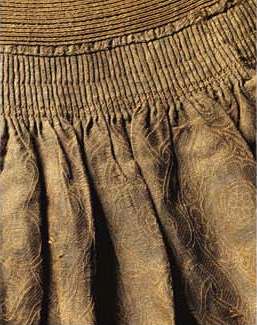 |
| Same source as extant at beginning |
I was talking with Elvira yesterday about garb fantasies and my sticking points. And there are two with this particular deel construction.
The pleats and the belt. The belt I'll get to in a minute, but the pleats I want to dive into more.
They way they sit they look like cartridge pleats. I've laid out cartridge pleats for other members of the household's garb. I know how to do it, but I have literally no evidence (there's no inside detail shot I can find) that this is, in fact, a type of cartridge pleat.
It's insanely neat and ordered, but without the evidence for cartridge pleating, I have to believe it's probably insanely small, and well organized, gathers. They appear to be sewn in 3 spots: one to the upper part of the coat, one in the center and then one a bit further down to reinforce the drape. Kind of like a proto-smocking, I suppose.
However, I really am not sure. I'll have to experiment, and likely fail, a few times before I work it out.
Now the belt.
That belt is a braided in small, smell braids, then sewn together. As a belt, it is not part of the actual coat itself, but holds it together between the waist and the hips. That's a lot of braiding. I don't braid well. That's a problem.
So, I've got some working out to do, which will require some experimentation. I would not expect as much about this ongoing experiment that I would about the other project, as it's more clear-cut in when I can start and stop, and what that will look like in terms of progress.
Photography and Garb Snobbery
I had started another post on variants in Mongol garb in period (which make it sound like some sort of terrible thesis paper), and I got sidetracked into something which should really be its own post. So, here I am! It's like a bonus update born out of my own rambling! Everyone hopefully wins!
This arose because I have seen gentles of all statures dabble in and out of Mongol. I think it's great, but I am often concerned about what their source materials are. From what I typically see from folks who don't entrench in Mongol, it's usually a turn into the "folk costume" trap.
This happens to a lot of people and how we got something like the "Irish Dress" which is questionably medieval and questionably ever worn as real clothing, outside of costume.
Taking the folk costume (like, from a Ren Faire or a cultural festival) and assuming it's "what they wore back then". Sometimes it's pretty close to the truth, which is real in the case of the Mongols. Often, though, it's gone through some changes and is really more of a costume than a heritage clothing piece, or throwback.
So, how does this all tie in together?
I'm a terrible, internal garb snark. I'm also pretty entrenched in what I'm doing at this point. I have a decent eye, now, to see where in the deel evolution something lies. And, more importantly, if someone is copying from a tribe they probably shouldn't.
This isn't to say I've not fallen into the trap, but to keep myself more accountable for myself, I created a Pinterest board dedicated to things which could look like or pass as period Mongol, but aren't.
The bottom line, though, is that if you can find it in a photograph -- whether colorized, color or black and white -- that's not of a piece of art or a surviving artifact, it's out of period.
This isn't to say that I'm not hugely excited to see someone swim in the warm waters of Mongol. There aren't many of us, to my understanding, that do it as a main persona. To see others do it makes me excited because visibility is huge, especially in a social organization like the SCA. I just have a gatekeeper/protective mentality when what I do doesn't look like what they do because my focus, intensity and sourcing is different.
This arose because I have seen gentles of all statures dabble in and out of Mongol. I think it's great, but I am often concerned about what their source materials are. From what I typically see from folks who don't entrench in Mongol, it's usually a turn into the "folk costume" trap.
This happens to a lot of people and how we got something like the "Irish Dress" which is questionably medieval and questionably ever worn as real clothing, outside of costume.
Taking the folk costume (like, from a Ren Faire or a cultural festival) and assuming it's "what they wore back then". Sometimes it's pretty close to the truth, which is real in the case of the Mongols. Often, though, it's gone through some changes and is really more of a costume than a heritage clothing piece, or throwback.
So, how does this all tie in together?
I'm a terrible, internal garb snark. I'm also pretty entrenched in what I'm doing at this point. I have a decent eye, now, to see where in the deel evolution something lies. And, more importantly, if someone is copying from a tribe they probably shouldn't.
This isn't to say I've not fallen into the trap, but to keep myself more accountable for myself, I created a Pinterest board dedicated to things which could look like or pass as period Mongol, but aren't.
The bottom line, though, is that if you can find it in a photograph -- whether colorized, color or black and white -- that's not of a piece of art or a surviving artifact, it's out of period.
This isn't to say that I'm not hugely excited to see someone swim in the warm waters of Mongol. There aren't many of us, to my understanding, that do it as a main persona. To see others do it makes me excited because visibility is huge, especially in a social organization like the SCA. I just have a gatekeeper/protective mentality when what I do doesn't look like what they do because my focus, intensity and sourcing is different.
A Little Off Topic -- King's and Queen's Equestrian Champions
I want to take a few inches to update on things that aren't about my research, but are relevant to this as an SCA blog.
I've mentioned before, most notably in my Birka posts, that I am a member of a robust household in Society -- House Strangewayes. We started out as a group of friends who played together, dipping our fingers into the different parts of what the SCA has to offer and, over time, we've started to take flight a bit, as well as grow.
I was part of the first real expansion of the House, and there's been a steady expansion since I came on board, almost 10 years ago.
Yesterday at KQ Equestrian Tournament and Champions, was a big day for the House.
First, one of our newest members, Gritta (who I don't believe has a blog, yet, for her work) received her Award of Arms. She's still very new into playing -- having attended her first event closing in on a year ago. In that time, she's really come right into making some quite exceptional German garb. Her sewing skills floor me, as I'm not the greatest craftsman at sewing.

It was a good day yesterday for all of us -- Shire, and House.
I've mentioned before, most notably in my Birka posts, that I am a member of a robust household in Society -- House Strangewayes. We started out as a group of friends who played together, dipping our fingers into the different parts of what the SCA has to offer and, over time, we've started to take flight a bit, as well as grow.
I was part of the first real expansion of the House, and there's been a steady expansion since I came on board, almost 10 years ago.
Yesterday at KQ Equestrian Tournament and Champions, was a big day for the House.
First, one of our newest members, Gritta (who I don't believe has a blog, yet, for her work) received her Award of Arms. She's still very new into playing -- having attended her first event closing in on a year ago. In that time, she's really come right into making some quite exceptional German garb. Her sewing skills floor me, as I'm not the greatest craftsman at sewing.

Gritta is on the bottom right-hand side in the feathered cap. At Birka 2016 (this photo), she won a special award for having the most historically accurate dress, by the eye of the judges, in the Fashion Show. It was well deserved and it was her first German garb ever! From there, she's been upping her skills and looking around at more examples of German.
I'm excited to see what else she does as the continues to wade into the SCA, and especially the Arts and Sciences. She's also become a fast friend of mine, specifically, so I was overjoyed to see her recognized by the Crown for the great work and even better conduct example she's been setting. She is a true asset to the Society and I'm thrilled that I get to call her a friend. I'm so proud of her recognition that I could gush for ages!
Fortune also received an induction into The Order of the Burdened Tyger. I've linked to the awards page for the East Kingdom, but it's a service award that is granted for exceptional service, typical for an event that required a huge amount of logistical rejiggering to work. Fortune, Lord Aleksei and other gentles I don't know in any way, received the induction for their work during Coronation.
Fortune outlines all that went into the event here, and it's a really great run down of how she in particular, and her leadership team overall, earned the Burdened Tyger. It's a "wow, awesome, big deal" kind of award. Fortune and I have been friends for over a decade now, before either of us were SCAdians. She's jumped into SCA and really has blossomed, both personally and skills-wise, since joining up. To see her receive an Award of Honor made my heart smile.
Between the two awards, it was a great day for good friends, for the Household, and I had a tinge of pride myself at knowing these people and helping to support them as they grow themselves, which is really what SCA is all about -- helping each other pursue our interests and growing together as humans.
Vivant to you both, and to all the recipients of awards, including the Shire as the first recipient of the Company of Fellowship for our willingness to come together as a community. Her Majesty, in her description, said beautifully that it shows the Shire is a group who thinks of the "we" instead of the "I" (and may be a tinge on the nutty side). I think it's a great testament that the Shire got awarded this new honor on the same day others received Burdened Tyger, which wouldn't have been possible without that same "we not me" attitude.
It was a good day yesterday for all of us -- Shire, and House.
Subscribe to:
Posts (Atom)