I've taken a longer than anticipated break from this than I was initially expecting. I don't have any new, exciting research breakthroughs or events attended or other real related SCA updates to share in terms of anything that pushes along what I've been doing.
That's not to say I've not been through changes when it comes to the SCA, and my place within it.
First of everything, I've officially, if quietly, stepped away from House Strangewayes. I had wished for it to have been a more amicable break than it turned out to be, but the maturity with which my leaving was handled was outside my control. I wish no ill will on the current members of the House, even now, and I have no intention of spread gross and dirty rumor through this (or any other) channel. Just rest assured, whoever may still be reading, that it's been about 8 months since I'd moved on from the House and I am much happier for it. I hope the House and the members continue to pursue their goals.
As you may have put together, this was around the same time that Trimgate happened, which was one of the last things I had updated on. Trimgate, as it's come to be known as I understand it, had a rather profound impact on me. The timing of it -- being essentially coincidental to my reassessing where I sat within the Society being a "free agent" -- gave me a lot of pause.
It turned what was going to be a few months of break while I got my head about me and figured out what I wanted to really do on my own, into the break you're seeing now. Frankly, the way it had been handled by the leadership within the SCA was a huge turn off at a time I was vulnerable. An open comment period, where I did write the Board, and then 7 months of no official statements regarding the incident, the issue of racism in general, and some of the problematic policies/practices which allowed for such an incident to occur. I was disappointed and, frankly, as a gay man with racial minority children, did not at all feel like I could be safe within the SCA. The threads of apologism that kept percolating up also didn't help.
If I'm going to participate in a hobby which expects me to show up, be counted and be seen in order to be considered a part of it, then I want that hobby to strenuously work to be a safe place for me and people like me. The SCA failed in that task.
I had kept a low, outside profile for the following months. Pennsic came and I was starting to feel a pang of nostalgia and want. I wanted to do it again. I wanted to figure out how to best go about participating in a way that I could presume my own safety. How I could make a mark, while also keeping my family safe. That, maybe, this was something that could be pushed for change, and that I could find a way to forgive the poor actions of the Board of Directors downward.
Then the Trimaris Order of Defense incident happened.
As a result, I dropped myself from all contact within the SCA. I cannot, at this point, associate myself with an organization so inept at the basics of racism and racial bias as to do nothing in the face of what is clearly a rising tide of white nationalism and white supremacy within the rank and file.
I didn't lose the SCA; the SCA lost me. I cannot and will not be associated with white nationalism, white supremacy and this kind of white ignorance. No hobby is worth that.
I may continue to do the research I love on my own, but I've not really decided what I'm going to do in regards to all of that. Right now, I've been focus on other passions in my life which I'd not been able to pursue because of the demands of my life, and the demands of the SCA.
I have a new job, at a new company. I have my two boys, who're my entire world. I have projects at home I've been putting off that I'm finally starting to tackle with the attention they deserve. I want to make my life more ecologically friendly -- from my consumerism to my landscaping and garden. All of these things I've been passionate about, but back burned to hobble along in the SCA as a persona no one really felt comfortable having.
I'm going to keep this blog up, because I think what I've already uncovered may be of some help to someone, but I am not going to make a concerted effort to continue my research, at least for now. Instead, I've been toying with starting a blog for my landscaping, gardening and sustainability efforts. I'm not totally sold on that, yet, because there is already a glut of those kinds of resources and voices, but it's on the radar.
Until next time.
26 August 2018
01 February 2018
Uncomfortable
Medieval Studies has a white supremacy problem.
Recently, this came knocking on the SCA's door with what's been called "trimgate". Royals outside my kingdom wore a commissioned garment with a trim based on the Snartemo V pattern. I will not link or display the image directly, as it would be a distraction. They have abdicated and their Kingdom is in a healing process right now. I'm not here to interrupt or otherwise impede the healing of another Kingdom, my Kingdom is still healing from its own, very different, trauma.
What I want to unpack is what I'm seeing as an aftermath. This is a departure from my usual writing, so if you've come here for research updates and the like, this is an entry you can certainly skip. I feel compelled to say something, anything, in the effort that my words can help explain what so many people are still feeling, and it requires me to break down the fantasy and build in the very real person who does the research into the hypothetical Erdeneqadajin.
I am a white gay man, and a father to two beautiful black children. My entire life outside the SCA is looks and judgments. I come to the SCA as an escape from the grind of life. Much of my found family plays the game; we encourage each other and support each other.
What I'm seeing is that this is not the rule, but rather the exception for people like me.
If you clicked on the link for the Snartemo V pattern, you can see the original is believed to have a fylfot, or Norse swastika. The interpretation that is causing the outrage took the swatiska, and matched it with other symbols of the Nazi party and the neo-Nazi movement. Whether this is based on an academic interpretation of the weave, or infused with artistic license, I don't think matters. What does matter is that it was there, large, in photographs for the SCA, devoid of context.
What matters more is that when there was an outrage, a justifiable outrage, those people were made to be the problem. They were told they were opposed to historicism, that the history of the garment outweighed the real history that came after it. The glossing over of the co-opting of Norse history by white supremacy and what could have been a real discussion of how the SCA, which is increasingly seeing a surge of Viking-age personae, separates people who are lovers of the real history of the Vikings from those who use the fantasy of Aryan crusaders ridding the world of non-Aryan people.
This echos the complaints about the harassment policy put in place to help combat bullying and sexual harassment that needed addressing right before the #MeToo movement exploded into consciousness. Where "the SJWs are ruining the game" with their "PC nonsense".
Even more, it's the same vein of complaint levied against Inspirational Equality, which was launched directly for people like me, who kept seeing men fight for their wives and wondered what the real harm was if a man wanted to fight for his husband (or wife for wife, of course). Once again, it was the SJWs making problems for the rest of the society, clutching their pearls about things that "weren't important".
At what point, then, do we admit that there is a huge problem with Reactionary Conservatism embedded within the culture of the SCA? When do we soul search and determine who wins -- the people who take into consideration the modern meanings and visuals of what we're doing in conjunction with the history we're looking to be inspired by?
More personally, who gets to feel comfortable in the SCA? The people who think it's ok to put swastika on garb, harass women and keep it straight? or is it the people who think that ignoring the importance of the swastika is Holocaust denial, think that all people should have protection and see no harm in letting other people fully participate?
I don't know if there's really enough people looking for an answer to that. That's a huge problem that needs addressing.
Recently, this came knocking on the SCA's door with what's been called "trimgate". Royals outside my kingdom wore a commissioned garment with a trim based on the Snartemo V pattern. I will not link or display the image directly, as it would be a distraction. They have abdicated and their Kingdom is in a healing process right now. I'm not here to interrupt or otherwise impede the healing of another Kingdom, my Kingdom is still healing from its own, very different, trauma.
What I want to unpack is what I'm seeing as an aftermath. This is a departure from my usual writing, so if you've come here for research updates and the like, this is an entry you can certainly skip. I feel compelled to say something, anything, in the effort that my words can help explain what so many people are still feeling, and it requires me to break down the fantasy and build in the very real person who does the research into the hypothetical Erdeneqadajin.
I am a white gay man, and a father to two beautiful black children. My entire life outside the SCA is looks and judgments. I come to the SCA as an escape from the grind of life. Much of my found family plays the game; we encourage each other and support each other.
What I'm seeing is that this is not the rule, but rather the exception for people like me.
If you clicked on the link for the Snartemo V pattern, you can see the original is believed to have a fylfot, or Norse swastika. The interpretation that is causing the outrage took the swatiska, and matched it with other symbols of the Nazi party and the neo-Nazi movement. Whether this is based on an academic interpretation of the weave, or infused with artistic license, I don't think matters. What does matter is that it was there, large, in photographs for the SCA, devoid of context.
What matters more is that when there was an outrage, a justifiable outrage, those people were made to be the problem. They were told they were opposed to historicism, that the history of the garment outweighed the real history that came after it. The glossing over of the co-opting of Norse history by white supremacy and what could have been a real discussion of how the SCA, which is increasingly seeing a surge of Viking-age personae, separates people who are lovers of the real history of the Vikings from those who use the fantasy of Aryan crusaders ridding the world of non-Aryan people.
This echos the complaints about the harassment policy put in place to help combat bullying and sexual harassment that needed addressing right before the #MeToo movement exploded into consciousness. Where "the SJWs are ruining the game" with their "PC nonsense".
Even more, it's the same vein of complaint levied against Inspirational Equality, which was launched directly for people like me, who kept seeing men fight for their wives and wondered what the real harm was if a man wanted to fight for his husband (or wife for wife, of course). Once again, it was the SJWs making problems for the rest of the society, clutching their pearls about things that "weren't important".
At what point, then, do we admit that there is a huge problem with Reactionary Conservatism embedded within the culture of the SCA? When do we soul search and determine who wins -- the people who take into consideration the modern meanings and visuals of what we're doing in conjunction with the history we're looking to be inspired by?
More personally, who gets to feel comfortable in the SCA? The people who think it's ok to put swastika on garb, harass women and keep it straight? or is it the people who think that ignoring the importance of the swastika is Holocaust denial, think that all people should have protection and see no harm in letting other people fully participate?
I don't know if there's really enough people looking for an answer to that. That's a huge problem that needs addressing.

13 January 2018
Sad Day
I feel like this a necessary update, but it tears my heart apart to post it. I'm going to take this right from my personal (non-SCA) Facebook page, with supporting other links inserted.
I was nearly ready to give up on the research I do. I was wondering if I should try a different persona or who knows what else.
Then I got a quest from the Queen and warm appreciation from the King. He shook my hand and calmed my nerves.
It is the small kindnesses that show you who someone really is.
There is hope Duke Kenric is still out there, waiting. And so we stoke those fires until the fuel is gone.
I don't know him well at all, but we quake at the loss of greatness, kindness and care.
To absent friends.
29 December 2017
Drive by Update
It's been since Summer that I've updated the blog, and I wanted to take a little bit of time to put something out there as an update.
This year real life threw some monkey wrenches in both good and bad ways. I have a personal policy of Real Life before SCA and so research stalled a bit. I was ok with taking a break, as I was getting overwhelmed with being stretched thin between kids, work, my non-playing spouse and one too many SCA-related challenges.
I've taken some time to retool how I organize my priorities and flex in the time I need to feel sane and get everything done I need to.
So, what that means is that I've started to get back into reading The Silk Road, but this time I am notating, margin noting and highlighting up a storm as I work my way through. I've loving being a student and getting questions down for further research. It's been a breath of fresh air to jump back in, only focusing solely on what I want to do.
It also means I'm not going to be making new garb until Spring at the earliest. I need to make Summer-ready garb and the problem is when I'm making it. It's difficult to make Summer breathable garb when it's barely making freezing outside, and I've been making my new piece of garb for the next year right around now in prep for Birka in Stonemarche.
This year, I'm going to make adjustments and repairs to the garb I made for last year's Birka (below).
This year real life threw some monkey wrenches in both good and bad ways. I have a personal policy of Real Life before SCA and so research stalled a bit. I was ok with taking a break, as I was getting overwhelmed with being stretched thin between kids, work, my non-playing spouse and one too many SCA-related challenges.
I've taken some time to retool how I organize my priorities and flex in the time I need to feel sane and get everything done I need to.
So, what that means is that I've started to get back into reading The Silk Road, but this time I am notating, margin noting and highlighting up a storm as I work my way through. I've loving being a student and getting questions down for further research. It's been a breath of fresh air to jump back in, only focusing solely on what I want to do.
It also means I'm not going to be making new garb until Spring at the earliest. I need to make Summer-ready garb and the problem is when I'm making it. It's difficult to make Summer breathable garb when it's barely making freezing outside, and I've been making my new piece of garb for the next year right around now in prep for Birka in Stonemarche.
This year, I'm going to make adjustments and repairs to the garb I made for last year's Birka (below).
 |
| I've lost the information for attribution. |
Mainly, though, I'm going to be getting myself prepped for teaching classes and helping with voice heraldry. Both fall into strength areas for me, and allow me to relax on things I've been pushing myself on, but haven't necessarily given me real joy. I'm not much on sewing, if I'm honest, but it's part of the deal (pun thoroughly intended).
01 July 2017
Supply Chains
The last posting here was a bit of a crisis point for me. I was looking down at what I was doing and I really, deeply was not feeling it. I was wavering and wiggling all around trying to figure out why, within the context of what I was doing. I was toying with dropping the whole thing, but not entirely seriously at that point.
Then, I made a trip to Barnes & Noble, because where else does a lost nerd go but to a place filled with information. I went there to pick up a bullet journal, but of course, left with a new book on the Silk Road. It's titled The Silk Road: A New History -- link takes you to B&N (I do not have sponsors; I get no personal gain from recommendations).
Normally, this would be an entirely unremarkable event. When I go to book stores, I typically scour their Asian history section/subsection to see what they have within my research wheelhouse. I have a decent digital archive, but I like actual books on real paper. I'm a highlighter and margin note taker. I can print out what I have digitally, but it's easier if it comes printed.
This time, though, it's caused a big shift. But first, a little background.
In my real life, I work in supply chain. I'm one of the many people who ensure that the products you want from a specific retailer is available for purchase in your area. Shipping, lead time, demand and vendor of origin are all concepts and challenges I contend with on a daily basis for our modern infrastructure. I love the intricacies of how products get from here to there -- manufacturer to end customer. It's one of my main draws to the Silk Routes -- studying how all these goods and peoples changed each other over time.
This book, though "study" could be as easily applicable a word, looks at it from the angle of my current job. The author looks at what moved along the Silk Roads in central and eastern Asia -- through sifting the old refuse pits for goods, wares and manifests.
It all unlocked at that point, for me. A specific focus on a specific hypothetical person is the wrong kind of narrow for me -- unfolding the character isn't what speaks to me. What I love are the things that make his environment: what language or languages did he speak - what did they sound like and how did they operate grammatically; what stuff would he consider normal and where did it come from; who would he had bought it from; what would be exotic and interesting but not entire abnormal?
I've decided a change in focus would do me good, at least for now. I'm going to dive into the operations of the Silk Routes and related trading routes. How did they work? How did folks typically travel before selling a good? What impact does political stability have on those distances?
I've already uncovered some clues -- the author of the book which kicked this off contends most traders traveled pretty exclusively between 2 to 3 cities (i.e. buy X, sell Y in New York; buy Y and sell X in Philadelphia). I want to see what other people who study this have seen to see if this is a prevalent or niche idea.
I'm gripped and fascinated in a way I haven't been for a while. This is a good sign to me, so I'm going to follow the road to see where it takes me.

This time, though, it's caused a big shift. But first, a little background.
In my real life, I work in supply chain. I'm one of the many people who ensure that the products you want from a specific retailer is available for purchase in your area. Shipping, lead time, demand and vendor of origin are all concepts and challenges I contend with on a daily basis for our modern infrastructure. I love the intricacies of how products get from here to there -- manufacturer to end customer. It's one of my main draws to the Silk Routes -- studying how all these goods and peoples changed each other over time.
This book, though "study" could be as easily applicable a word, looks at it from the angle of my current job. The author looks at what moved along the Silk Roads in central and eastern Asia -- through sifting the old refuse pits for goods, wares and manifests.
It all unlocked at that point, for me. A specific focus on a specific hypothetical person is the wrong kind of narrow for me -- unfolding the character isn't what speaks to me. What I love are the things that make his environment: what language or languages did he speak - what did they sound like and how did they operate grammatically; what stuff would he consider normal and where did it come from; who would he had bought it from; what would be exotic and interesting but not entire abnormal?
I've decided a change in focus would do me good, at least for now. I'm going to dive into the operations of the Silk Routes and related trading routes. How did they work? How did folks typically travel before selling a good? What impact does political stability have on those distances?
I've already uncovered some clues -- the author of the book which kicked this off contends most traders traveled pretty exclusively between 2 to 3 cities (i.e. buy X, sell Y in New York; buy Y and sell X in Philadelphia). I want to see what other people who study this have seen to see if this is a prevalent or niche idea.
I'm gripped and fascinated in a way I haven't been for a while. This is a good sign to me, so I'm going to follow the road to see where it takes me.
20 April 2017
Struggles and Thoughts
I have a confession.
I haven't been doing any work on research recently. To be completely honest, I'm struggling.
There are multiple reasons why this is the case and, in the light of transparency and honesty, I do want to go through and unpack them. The best way to get through a block is to attack it head on.
I've lost my way. What I'm looking to do I'm enthusiastic about in theory, but not so much in actual practice. Having a deep dive understanding on a specific time and place is really cool, but I don't know if that's really for me.
Something I'm learning the hard way is that it's not so much that I'm interested in the Mongols of themselves. They're a puzzle for even the most skilled anthropologist, doing on the ground work. The sources about the Mongols themselves is highly flawed -- whether it's using centuries later transcribed oral history, or contemporary accounts from rival cultures and/or conquered people, there's no way there can be any surety in that what is being sifted is accurate.
What I'm really interested in is following the ripples from the Mongol stone. What are the implications of the Mongol invasions? How did the hasten changes in the cultures they ruled? What were the intended and unintended consequences of those conquests and exchanges? What access did the cultures gain and lose they would not have had otherwise?
Something I'm also learning is that my SCA experience is prefaced around exploration and academics.
I'm not very much into persona, or the LARP-like aspects. I don't have much investment in the building of a specific and discrete person who may have existed. I'm certainly appreciative of the pageantry and ceremony. But, I can't say I'd personally have an interest in doing something like an Enchanted Ground event, or something High Persona.
Some people are super into that and I am, by no means, trying to harsh on their fun. If that's what you love about the SCA, absolutely continue to do it! Enjoy it to the ends of time and spread your joy and enthusiasm far and wide! That joy is part of what makes the Society great. It's just not particularly for me.
The result of this is that digging deep into a persona build doesn't hold the same appeal to me that it might to others. Building research around building a persona isn't resonating with me because having that deep of a persona isn't something I'm truly invested in.
I'm content with being the vague ethnic Mongol, Yuan period court member, as it allows me to show off any level of material wealth I want to try out. It's more a means to an end, as opposed to an end to the means.
I'm not sure what all this means in terms of my research. I still have a love of linguistics and grammar, so that project isn't going to go away. But, the rest of it is something I'm really starting to pull into question.
I definitely need to re-evaluate what I'm looking at otherwise. This shoe doesn't feel like it fits properly and it's a strange place to be in.
I haven't been doing any work on research recently. To be completely honest, I'm struggling.
There are multiple reasons why this is the case and, in the light of transparency and honesty, I do want to go through and unpack them. The best way to get through a block is to attack it head on.
I've lost my way. What I'm looking to do I'm enthusiastic about in theory, but not so much in actual practice. Having a deep dive understanding on a specific time and place is really cool, but I don't know if that's really for me.
Something I'm learning the hard way is that it's not so much that I'm interested in the Mongols of themselves. They're a puzzle for even the most skilled anthropologist, doing on the ground work. The sources about the Mongols themselves is highly flawed -- whether it's using centuries later transcribed oral history, or contemporary accounts from rival cultures and/or conquered people, there's no way there can be any surety in that what is being sifted is accurate.
What I'm really interested in is following the ripples from the Mongol stone. What are the implications of the Mongol invasions? How did the hasten changes in the cultures they ruled? What were the intended and unintended consequences of those conquests and exchanges? What access did the cultures gain and lose they would not have had otherwise?
Something I'm also learning is that my SCA experience is prefaced around exploration and academics.
I'm not very much into persona, or the LARP-like aspects. I don't have much investment in the building of a specific and discrete person who may have existed. I'm certainly appreciative of the pageantry and ceremony. But, I can't say I'd personally have an interest in doing something like an Enchanted Ground event, or something High Persona.
Some people are super into that and I am, by no means, trying to harsh on their fun. If that's what you love about the SCA, absolutely continue to do it! Enjoy it to the ends of time and spread your joy and enthusiasm far and wide! That joy is part of what makes the Society great. It's just not particularly for me.
The result of this is that digging deep into a persona build doesn't hold the same appeal to me that it might to others. Building research around building a persona isn't resonating with me because having that deep of a persona isn't something I'm truly invested in.
I'm content with being the vague ethnic Mongol, Yuan period court member, as it allows me to show off any level of material wealth I want to try out. It's more a means to an end, as opposed to an end to the means.
I'm not sure what all this means in terms of my research. I still have a love of linguistics and grammar, so that project isn't going to go away. But, the rest of it is something I'm really starting to pull into question.
I definitely need to re-evaluate what I'm looking at otherwise. This shoe doesn't feel like it fits properly and it's a strange place to be in.
04 March 2017
Best Ideas at Night
There's a word-on-the-street maxium that says some of your best ideas and thoughts happen when you're least expecting them -- in the shower, right before falling asleep, when driving on the open road and the like. Any time when your mind can bring those twisty-turny thoughts more to the front and start to do some untying and solving.
I had one of those moments last night while drifting to sleep related to research.
With the new direction, I've been feeling a bit adrift and so have lost a bit of my researching mojo. I am still utterly fascinated by the Yuan dynasty era Mongols, so I'm not feeling a persona change or anything drastic. It's more that I haven't been able to dedicate myself to making a game plan on incorporating new information and approaches.
It's made it especially difficult to read the newer research information I've compiled because I've been struggling with where it "fits" in what I'm looking at. It feel both relevant and irrelevant to what I'm doing, and the ambiguity is sapping my ability to focus when I have the chance. The little voice in my back of my head says "and this helps you how?" and I'm having a time understanding not only the "why" of the question but actually answering it.
Last night, I think I solved it, but it requires some work to make a frame on which to hang everything.
The new direction is more than just looking at stuff out of the ground. I've oversimplified it because it's easier to talk about it that way, before refining the idea.
The new direction is a holistic look at the material and other cultural aspects of the idea of my persona. So, more than "what all did you wear?" it's also "what all did you eat? what would your social standing be? how did you get there? what's your religious background? what languages would you speak?" and other related questions.
So, instead of a deep dive into a narrow subject, it's a deep dive into a narrow time.
What came to me last night was a pretty simple, though somewhat profound, idea. Literally organizing Erdene's life into departments.
Just like a real department store, they'll bleed into each other like how activewear and formalwear are separate, but the connect through casual clothing.
What I've come up with so far is:
Food: What did he eat? With whom did he eat it? How often could he expect to eat? Would it have changed moving from the frontier to the heart of the Empire?
Faith: What would his religion probably have been? What other religions would he had been exposed to? How did they come together? Who celebrated what faiths? Would he have had a different faith than his neighbors? parents? siblings? What were the prevailing philosophies of the time?
Social: What social biases did he have? Would he have been considered a racist by modern standards? How would growing up on the Silk Routs have changed his view of outsiders? Would he be in an ethnically mixed environment, or would it have been homogenous? Who would he consider 'his people'? How would he identify his in-groups and his out-groups?
Government: How would he understand his government? Would the government be supportive or oppressive to his religious and other markers? What would have been his most probably role in government? Who're the major players in the government? What does the bureaucracy look like (since this is China)? Who is eligible to be a Civil Servant?
Material: What did he own? How would he have bought or gotten it? What are his clothes made of? How are they constructed? What does he live in? Is it portable? Is he still nomadic or has he settled?
Again, all of these topics and questions overlap each other and inform each other. Some can be answered by traditional archaeology, others will need historical study. But, by having the archaeological study background first, I can use that to do gut-checking on the historian's interpretation of social structures and customs.
I had one of those moments last night while drifting to sleep related to research.
With the new direction, I've been feeling a bit adrift and so have lost a bit of my researching mojo. I am still utterly fascinated by the Yuan dynasty era Mongols, so I'm not feeling a persona change or anything drastic. It's more that I haven't been able to dedicate myself to making a game plan on incorporating new information and approaches.
It's made it especially difficult to read the newer research information I've compiled because I've been struggling with where it "fits" in what I'm looking at. It feel both relevant and irrelevant to what I'm doing, and the ambiguity is sapping my ability to focus when I have the chance. The little voice in my back of my head says "and this helps you how?" and I'm having a time understanding not only the "why" of the question but actually answering it.
Last night, I think I solved it, but it requires some work to make a frame on which to hang everything.
The new direction is more than just looking at stuff out of the ground. I've oversimplified it because it's easier to talk about it that way, before refining the idea.
The new direction is a holistic look at the material and other cultural aspects of the idea of my persona. So, more than "what all did you wear?" it's also "what all did you eat? what would your social standing be? how did you get there? what's your religious background? what languages would you speak?" and other related questions.
So, instead of a deep dive into a narrow subject, it's a deep dive into a narrow time.
What came to me last night was a pretty simple, though somewhat profound, idea. Literally organizing Erdene's life into departments.
Just like a real department store, they'll bleed into each other like how activewear and formalwear are separate, but the connect through casual clothing.
What I've come up with so far is:
Food: What did he eat? With whom did he eat it? How often could he expect to eat? Would it have changed moving from the frontier to the heart of the Empire?
Faith: What would his religion probably have been? What other religions would he had been exposed to? How did they come together? Who celebrated what faiths? Would he have had a different faith than his neighbors? parents? siblings? What were the prevailing philosophies of the time?
Social: What social biases did he have? Would he have been considered a racist by modern standards? How would growing up on the Silk Routs have changed his view of outsiders? Would he be in an ethnically mixed environment, or would it have been homogenous? Who would he consider 'his people'? How would he identify his in-groups and his out-groups?
Government: How would he understand his government? Would the government be supportive or oppressive to his religious and other markers? What would have been his most probably role in government? Who're the major players in the government? What does the bureaucracy look like (since this is China)? Who is eligible to be a Civil Servant?
Material: What did he own? How would he have bought or gotten it? What are his clothes made of? How are they constructed? What does he live in? Is it portable? Is he still nomadic or has he settled?
Again, all of these topics and questions overlap each other and inform each other. Some can be answered by traditional archaeology, others will need historical study. But, by having the archaeological study background first, I can use that to do gut-checking on the historian's interpretation of social structures and customs.
19 February 2017
Temporary Pause in Updates
I know it's only been a couple weeks, but I wanted to take the opportunity to update you all on the goings on here.
I'm pursuing a new research direction for the Clothing Project and, as a result, I'm in the process of collecting resources and information for the new angle.
I'm shifting, at least for right now, from looking at art, to looking at what's been pulled out from the ground in archaeological digs. The best way to know who wore what, is to pull it from a grave complex.
As is my typical, I am starting with China's Yuan dynasty. It's more in my persona's realm, and I've always been more naturally drawn to China. Persian is hugely interesting and I'm not looking to drop it, don't get me wrong, but my love of all things Sinology is deep and abiding.
This does mean I will need to take a pause while I read and digest what others have found, and their conclusions. I like to make sure I have a good baseline before I walk off on my own, drawing conclusions and making hypotheses.
I am also in the very beginning stages of forming a class on basic construction of Mongol deel. The earliest debut would be at Great Northeastern War this summer. I'd use examples from my own failed garb closet to build on the case, and use a type of visual example not seen frequently: the own teacher's process in learning.
More on that, most likely, before anything else.
Thank you for your patience!
29 January 2017
Excitement
I took a big step this weekend.
This weekend was the Market Day at Birka event here in the East. It's the largest event that the Barony of Stonemache (New Hampshire) does and I make it a point to get there every year. It always a source of inspiration for me when I see what other people do. The A&S display inspires me to get my hands into things more, there are always a few peerages earned (because it is work and dedication to get there), the fashion show where we all get to peacock just a little bit; it's just a great event that I really enjoy. It breathes some life into me after the long slog of the holidays and just getting through the tough, New England winter.
To take a step back, I've been doing my various research projects for a while now, as life has allowed. I'm getting to a point where I need to have some help in how to overcome some of the challenges I'm reaching. That tells me I need the assistance of someone who's been there before, or at least can help me move through, around or over those walls.
I'd talked about how I was feeling the need to have some additional help with some members of my house. One of my housemates, Elvira, had been taken on as a student of one of our friends who is a Laurel, Baroness V.
Over the course of many months, Elvira and I talked about how the student-teacher relationship functioned, what it means, how it changes the way she approaches the game, as well as general pros and cons of the process. It gave me a great deal of insight and a reassurance that I did need to find someone who could me overcome my research troubles, while also respecting that my life is hugely chaotic and dynamic at times.
Over the course of many months, Elvira and I talked about how the student-teacher relationship functioned, what it means, how it changes the way she approaches the game, as well as general pros and cons of the process. It gave me a great deal of insight and a reassurance that I did need to find someone who could me overcome my research troubles, while also respecting that my life is hugely chaotic and dynamic at times.
Baroness V and I have been getting to know each other more and more over the past year, when she kind of burst onto my scene (even though she is well established in her own right). We have a similar outlook on life and understanding of the importance of valuing real life over the SCA. In addition to that, before her current persona, she earned her Laurel for doing ground breaking and difficult deep dives in the creation of a Indian persona.
So, in addition to being a great personality fit, she's also a great research fit, have blazed a similar trail with a different culture.
At the event, I got to really be able to talk to her at the event regarding my research. I'd been trying to get the opportunity to do it, but life got in the way. We talked through the major points, where I'm at, an elevator version of this blog, too, and she was really digging it.
So, I asked if she could taken me on as a student. It was a bit bold on my part, as I don't know the decorum, but I did it.
So, I asked if she could taken me on as a student. It was a bit bold on my part, as I don't know the decorum, but I did it.
She said yes.
I now have a peer to work with in a student-teacher relationship and I couldn't be happier with the step. I'm excited to see where this takes things, as I've already got a research source direction change out of the conversation to help things along better.
I don't think I've been this excited about my research in a while.
28 August 2016
History Is Messy: lessons in research, the hard way
So, I did a little cursory grammatical searching based off of the leads I left myself in my last post on the Titles Project, because this blog is just as much for my own reference as it is for anyone who's reading it to dive into my insanely, esoterically quirky interests.
As a review, I mentioned exploiting the Wikipedia page for Middle Mongol's references. I went back to that today and one of the links piqued my interest.
Lingua Mongolica is listed as a source on that page.
I was doing a read through on the intro page for them. There was something that stuck out to me in particular:
Now, what that amounts to is a conceit that pre-classical Mongolian, in my case Middle Mongol, is entirely non-standard and, therefor, unreliable. I had backtracked my way into figuring that out previously, but seeing a source explicitly state as much is both comforting and frustrating.
There's more that also piqued my interest here in the resource (emphasis mine):
We'll see how much matches between the notes on Introduction I took and "Lingua Mongolica's" modelling of the language to see what I can suss out. Introduction is a linguistic basis; I've yet to dig in far enough to see what "Lingua" has.
As a review, I mentioned exploiting the Wikipedia page for Middle Mongol's references. I went back to that today and one of the links piqued my interest.
Lingua Mongolica is listed as a source on that page.
I was doing a read through on the intro page for them. There was something that stuck out to me in particular:
The term 'classical Mongolian' technically refers only to the language of the seventeenth and eighteenth centuries, when the written Mongolian language was standardised in order to facilitate the translation of Buddhist literature.That stuck out to me because non-standard ways of writing, while not unique to Mongolian, means there's no one way, both in spelling and alphabet, to write pre-classical Mongolian.
Now, what that amounts to is a conceit that pre-classical Mongolian, in my case Middle Mongol, is entirely non-standard and, therefor, unreliable. I had backtracked my way into figuring that out previously, but seeing a source explicitly state as much is both comforting and frustrating.
There's more that also piqued my interest here in the resource (emphasis mine):
The focus of Lingua Mongolia is not strictly the classical language but rather the literary language of the Mongols over the last eight hundred years; from the pre-classical Mongolian of the Secret History right up to modern literary Mongolian, as it still exists in Inner Mongolia. It is worth noting however that the term classical Mongolian is sometimes used to distinguish Uighur-script Mongolian from the Cyrillic Mongolian used by the Mongols north of the Gobi.With that in mind, I could, possibly, use Uighar vertical, sometimes also called Sogdian vertical, script and bring it to "close enough". Introduction the first source is based specifically in Sogdian vertical, kicking it back into contention.
We'll see how much matches between the notes on Introduction I took and "Lingua Mongolica's" modelling of the language to see what I can suss out. Introduction is a linguistic basis; I've yet to dig in far enough to see what "Lingua" has.
Something Mongol and NOT grammar or titles?! WHAT CRAZY IS THIS
I've put a lot of time into the Grammar and Titles project recently, which has been reflected here, but I also have been looking at my next garb project for generally usable garb -- so not a special challenge or theme.
I'm multi-talented, or maybe ADD, like that. I like to think multi-talented, but sometimes I get bored and my interests wander off to something which isn't my main focus for a while.
I want to make something inspired by this:
Now, you might be thinking "this doesn't look that much different than what you usually do" and you'd be both right and a bit off base.
First, the general construction of Mongol deels hasn't really changed much over the passing centuries. I believe I've talked to the basic construction before, but in case I haven't, the general pattern I have memorized is here. I do some modifications, like I will take out the panel extensions because of the fit I usually do, which is loose in the lower half, but you can see the basics of it in any of the pictures of me I've posted up here for head-to-toe analysis and the like.
Now, unsurprising to most people who study it, but history is messy. People then, like now, don't fall into these discrete and easy groupings, and with that, comes variations across.
In China, the strong influence of the Chinese ethnic groups means that I generally haven't seen the deels like the above. They tend to be less fitted, longer and more simple in design and construction, relying on the strength and prominence of the fabric to do the talking.
The example above, is from the Persian sphere of influence. What that means is that the Mongols changed their deel a bit, the longer they were there, until it becomes the cross-over coat that the early Mughals wore, at least until Period ends in the early 17th century.
It looks like this:
Jumping back, though, I've got some working out to do on the pleating. Pleating is not something I readily understand in terms of how to construct them. I know there are different kinds of pleats which sit different ways.
First, a close up of the pleating:
I really enjoy this detail shot because I have seen numerous examples from the Persian sphere of Mongol cross-over coats having this silhouette and general construction pattern.
I was talking with Elvira yesterday about garb fantasies and my sticking points. And there are two with this particular deel construction.
The pleats and the belt. The belt I'll get to in a minute, but the pleats I want to dive into more.
They way they sit they look like cartridge pleats. I've laid out cartridge pleats for other members of the household's garb. I know how to do it, but I have literally no evidence (there's no inside detail shot I can find) that this is, in fact, a type of cartridge pleat.
It's insanely neat and ordered, but without the evidence for cartridge pleating, I have to believe it's probably insanely small, and well organized, gathers. They appear to be sewn in 3 spots: one to the upper part of the coat, one in the center and then one a bit further down to reinforce the drape. Kind of like a proto-smocking, I suppose.
However, I really am not sure. I'll have to experiment, and likely fail, a few times before I work it out.
Now the belt.
That belt is a braided in small, smell braids, then sewn together. As a belt, it is not part of the actual coat itself, but holds it together between the waist and the hips. That's a lot of braiding. I don't braid well. That's a problem.
So, I've got some working out to do, which will require some experimentation. I would not expect as much about this ongoing experiment that I would about the other project, as it's more clear-cut in when I can start and stop, and what that will look like in terms of progress.
I'm multi-talented, or maybe ADD, like that. I like to think multi-talented, but sometimes I get bored and my interests wander off to something which isn't my main focus for a while.
I want to make something inspired by this:
 |
| source |
First, the general construction of Mongol deels hasn't really changed much over the passing centuries. I believe I've talked to the basic construction before, but in case I haven't, the general pattern I have memorized is here. I do some modifications, like I will take out the panel extensions because of the fit I usually do, which is loose in the lower half, but you can see the basics of it in any of the pictures of me I've posted up here for head-to-toe analysis and the like.
Now, unsurprising to most people who study it, but history is messy. People then, like now, don't fall into these discrete and easy groupings, and with that, comes variations across.
In China, the strong influence of the Chinese ethnic groups means that I generally haven't seen the deels like the above. They tend to be less fitted, longer and more simple in design and construction, relying on the strength and prominence of the fabric to do the talking.
The example above, is from the Persian sphere of influence. What that means is that the Mongols changed their deel a bit, the longer they were there, until it becomes the cross-over coat that the early Mughals wore, at least until Period ends in the early 17th century.
It looks like this:
 |
| source |
First, a close up of the pleating:
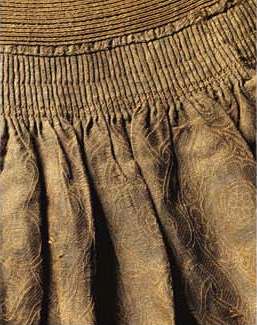 |
| Same source as extant at beginning |
I was talking with Elvira yesterday about garb fantasies and my sticking points. And there are two with this particular deel construction.
The pleats and the belt. The belt I'll get to in a minute, but the pleats I want to dive into more.
They way they sit they look like cartridge pleats. I've laid out cartridge pleats for other members of the household's garb. I know how to do it, but I have literally no evidence (there's no inside detail shot I can find) that this is, in fact, a type of cartridge pleat.
It's insanely neat and ordered, but without the evidence for cartridge pleating, I have to believe it's probably insanely small, and well organized, gathers. They appear to be sewn in 3 spots: one to the upper part of the coat, one in the center and then one a bit further down to reinforce the drape. Kind of like a proto-smocking, I suppose.
However, I really am not sure. I'll have to experiment, and likely fail, a few times before I work it out.
Now the belt.
That belt is a braided in small, smell braids, then sewn together. As a belt, it is not part of the actual coat itself, but holds it together between the waist and the hips. That's a lot of braiding. I don't braid well. That's a problem.
So, I've got some working out to do, which will require some experimentation. I would not expect as much about this ongoing experiment that I would about the other project, as it's more clear-cut in when I can start and stop, and what that will look like in terms of progress.
Photography and Garb Snobbery
I had started another post on variants in Mongol garb in period (which make it sound like some sort of terrible thesis paper), and I got sidetracked into something which should really be its own post. So, here I am! It's like a bonus update born out of my own rambling! Everyone hopefully wins!
This arose because I have seen gentles of all statures dabble in and out of Mongol. I think it's great, but I am often concerned about what their source materials are. From what I typically see from folks who don't entrench in Mongol, it's usually a turn into the "folk costume" trap.
This happens to a lot of people and how we got something like the "Irish Dress" which is questionably medieval and questionably ever worn as real clothing, outside of costume.
Taking the folk costume (like, from a Ren Faire or a cultural festival) and assuming it's "what they wore back then". Sometimes it's pretty close to the truth, which is real in the case of the Mongols. Often, though, it's gone through some changes and is really more of a costume than a heritage clothing piece, or throwback.
So, how does this all tie in together?
I'm a terrible, internal garb snark. I'm also pretty entrenched in what I'm doing at this point. I have a decent eye, now, to see where in the deel evolution something lies. And, more importantly, if someone is copying from a tribe they probably shouldn't.
This isn't to say I've not fallen into the trap, but to keep myself more accountable for myself, I created a Pinterest board dedicated to things which could look like or pass as period Mongol, but aren't.
The bottom line, though, is that if you can find it in a photograph -- whether colorized, color or black and white -- that's not of a piece of art or a surviving artifact, it's out of period.
This isn't to say that I'm not hugely excited to see someone swim in the warm waters of Mongol. There aren't many of us, to my understanding, that do it as a main persona. To see others do it makes me excited because visibility is huge, especially in a social organization like the SCA. I just have a gatekeeper/protective mentality when what I do doesn't look like what they do because my focus, intensity and sourcing is different.
This arose because I have seen gentles of all statures dabble in and out of Mongol. I think it's great, but I am often concerned about what their source materials are. From what I typically see from folks who don't entrench in Mongol, it's usually a turn into the "folk costume" trap.
This happens to a lot of people and how we got something like the "Irish Dress" which is questionably medieval and questionably ever worn as real clothing, outside of costume.
Taking the folk costume (like, from a Ren Faire or a cultural festival) and assuming it's "what they wore back then". Sometimes it's pretty close to the truth, which is real in the case of the Mongols. Often, though, it's gone through some changes and is really more of a costume than a heritage clothing piece, or throwback.
So, how does this all tie in together?
I'm a terrible, internal garb snark. I'm also pretty entrenched in what I'm doing at this point. I have a decent eye, now, to see where in the deel evolution something lies. And, more importantly, if someone is copying from a tribe they probably shouldn't.
This isn't to say I've not fallen into the trap, but to keep myself more accountable for myself, I created a Pinterest board dedicated to things which could look like or pass as period Mongol, but aren't.
The bottom line, though, is that if you can find it in a photograph -- whether colorized, color or black and white -- that's not of a piece of art or a surviving artifact, it's out of period.
This isn't to say that I'm not hugely excited to see someone swim in the warm waters of Mongol. There aren't many of us, to my understanding, that do it as a main persona. To see others do it makes me excited because visibility is huge, especially in a social organization like the SCA. I just have a gatekeeper/protective mentality when what I do doesn't look like what they do because my focus, intensity and sourcing is different.
A Little Off Topic -- King's and Queen's Equestrian Champions
I want to take a few inches to update on things that aren't about my research, but are relevant to this as an SCA blog.
I've mentioned before, most notably in my Birka posts, that I am a member of a robust household in Society -- House Strangewayes. We started out as a group of friends who played together, dipping our fingers into the different parts of what the SCA has to offer and, over time, we've started to take flight a bit, as well as grow.
I was part of the first real expansion of the House, and there's been a steady expansion since I came on board, almost 10 years ago.
Yesterday at KQ Equestrian Tournament and Champions, was a big day for the House.
First, one of our newest members, Gritta (who I don't believe has a blog, yet, for her work) received her Award of Arms. She's still very new into playing -- having attended her first event closing in on a year ago. In that time, she's really come right into making some quite exceptional German garb. Her sewing skills floor me, as I'm not the greatest craftsman at sewing.

It was a good day yesterday for all of us -- Shire, and House.
I've mentioned before, most notably in my Birka posts, that I am a member of a robust household in Society -- House Strangewayes. We started out as a group of friends who played together, dipping our fingers into the different parts of what the SCA has to offer and, over time, we've started to take flight a bit, as well as grow.
I was part of the first real expansion of the House, and there's been a steady expansion since I came on board, almost 10 years ago.
Yesterday at KQ Equestrian Tournament and Champions, was a big day for the House.
First, one of our newest members, Gritta (who I don't believe has a blog, yet, for her work) received her Award of Arms. She's still very new into playing -- having attended her first event closing in on a year ago. In that time, she's really come right into making some quite exceptional German garb. Her sewing skills floor me, as I'm not the greatest craftsman at sewing.

Gritta is on the bottom right-hand side in the feathered cap. At Birka 2016 (this photo), she won a special award for having the most historically accurate dress, by the eye of the judges, in the Fashion Show. It was well deserved and it was her first German garb ever! From there, she's been upping her skills and looking around at more examples of German.
I'm excited to see what else she does as the continues to wade into the SCA, and especially the Arts and Sciences. She's also become a fast friend of mine, specifically, so I was overjoyed to see her recognized by the Crown for the great work and even better conduct example she's been setting. She is a true asset to the Society and I'm thrilled that I get to call her a friend. I'm so proud of her recognition that I could gush for ages!
Fortune also received an induction into The Order of the Burdened Tyger. I've linked to the awards page for the East Kingdom, but it's a service award that is granted for exceptional service, typical for an event that required a huge amount of logistical rejiggering to work. Fortune, Lord Aleksei and other gentles I don't know in any way, received the induction for their work during Coronation.
Fortune outlines all that went into the event here, and it's a really great run down of how she in particular, and her leadership team overall, earned the Burdened Tyger. It's a "wow, awesome, big deal" kind of award. Fortune and I have been friends for over a decade now, before either of us were SCAdians. She's jumped into SCA and really has blossomed, both personally and skills-wise, since joining up. To see her receive an Award of Honor made my heart smile.
Between the two awards, it was a great day for good friends, for the Household, and I had a tinge of pride myself at knowing these people and helping to support them as they grow themselves, which is really what SCA is all about -- helping each other pursue our interests and growing together as humans.
Vivant to you both, and to all the recipients of awards, including the Shire as the first recipient of the Company of Fellowship for our willingness to come together as a community. Her Majesty, in her description, said beautifully that it shows the Shire is a group who thinks of the "we" instead of the "I" (and may be a tinge on the nutty side). I think it's a great testament that the Shire got awarded this new honor on the same day others received Burdened Tyger, which wouldn't have been possible without that same "we not me" attitude.
It was a good day yesterday for all of us -- Shire, and House.
14 August 2016
Continued Research in the Titles Project
I hit a snag with the resource I lifted from yesterday as far as being a truly period (read: pre-1600) resource. Classical Mongolian comes into real life around 1700. That century is troublesome.
It provides some workable thoughts, but just like Old English, Middle English and Modern English are related, but significantly different, so also is Modern, Classical and Middle Mongolian would suffer many of the same problems.
It's a good launching pad, but I need to find a dictionary and grammatical syntax rules book like Introduction to Classical has.
In an attempt to get things rolling again in a more solid direction, I'm starting with Wikipedia's article on Middle Mongolian as a jumping point. They list their sources and they're fairly extensive. While I may find different information from those sources, this is Wikipedia after all, I can get in the dirt in the very least focusing on the language the Mongols of the SCA period actually spoke.
It provides some workable thoughts, but just like Old English, Middle English and Modern English are related, but significantly different, so also is Modern, Classical and Middle Mongolian would suffer many of the same problems.
It's a good launching pad, but I need to find a dictionary and grammatical syntax rules book like Introduction to Classical has.
In an attempt to get things rolling again in a more solid direction, I'm starting with Wikipedia's article on Middle Mongolian as a jumping point. They list their sources and they're fairly extensive. While I may find different information from those sources, this is Wikipedia after all, I can get in the dirt in the very least focusing on the language the Mongols of the SCA period actually spoke.
13 August 2016
Quest/Titles Project Update
I had mentioned before how the information listed on the EK Alternative Titles page was a bit lackluster, which inspired me to go on an extended project based on a quest given to me by Her Majesty, Queen Avelina.
Well, I made some major progress, but before I get to that, let me take a step back.
Looping into today's earlier post, I have to rely on newer Mongolian vocabulary and grammar than the time period I focus on. I've come to accept that I don't yet have the research skills, nor the linguistic know-how to get a truly good insight into what I want for my exact person. And, since this is turning into something which could go to the common good of the Society, having something workable, if not up to my specific persona, is much better than being in perpetual frustration and doubt.
With that being said, I took a look at the resources that are available for Mongol Naming Practices and got my hands on (thanks to a Household member who's a professional librarian) an out-of-print book that focuses specifically on Mongol Grammar.
It's titled Introduction to Classical (Literary) Mongolian (parenthesis theirs), It is, in a word, a gold mine that I'm super happy I pursued on a gut instinct.
I just got through the read of the title and took, well, copious notes including vocabulary listings, and the grammatical structures for Mongol nouns, adjectives and adverbs. I know, I'm weird. I like understanding grammar rules. It's as close to mathy as I think I could ever get.
Anyhow, I started a quick and dirty list of words I think could be helpful, not only for titles themselves but also general use at a Royal level. In my own notes, I cite the page I found the word so when I submit everything will be properly documented.
Here's the list, unedited and raw (meaning lacking diacritical markings and only Roman letters):
Qagan -- King
Koebgun -- son/boy
Degu - younger brother
Eke - mother
Bars - tiger
Aqa - elder brother
Qatun - Queen
Cerig - soldier
lama - priest/lama
moritu - rider/horseman
noyan - prince/lord
Qan - minor prince, lord (this would be the title I was asked to find, guys. STOKED)
ulus - people/nation
tusimel - minister/official
arsalan - lion
abagan - master, sire
juljagan - young, offspring
ocuguken - minor/subordinate
degedu - high, elevated
aldartan said -- celebrities, famous poeple
ama|n - family, household
arga - art, craft, plan; trick
ayag-qa - rank of priest; gelung
baga - small, young
bagsi - teacher/scholar
bars, baras - tiger
elci - envoy, embassador
erkim - supreme, chief, outstanding
jarudasu|n - slave, servant, messenger (messenger is the meaning I'm going for)
keukid - children
nokor - comrade, friend, companion (pl. nokod)
Qan kobegun - prince
qaragulci - guard, shepherd
qaragul - sentinel, guard
tusimel - official, minister
quda - brother-in-law, cousin
I think this is a good base to start from. I do want to find more resources, aside from Wikipedia the open encyclopedia of sometimes ok information, to bolster the list. But, it's definitely a strong start.
I'm also going to organize my notes in a way which makes presenting the declensions easier to understand for a non-grammatically inclined person. The grammar becomes important for naming practices with the heralds, as well as any other awards or designations that may be created or given out.
But, that is where I sit right now with the project. It feels great to have some progress made and something workable I can present to Her Majesty.
Challenges of Researching Mongols, and Strategies I Employ
I'm going to take a second to talk through why I usually take what probably looks like a ludicrously roundabout way to piece together information for my persona. I think it's a good reminder that not all topics are created equal, and also to demonstrate that sometimes you've just got to work smart to get where you want to be.
The Big Thing to Remember about the Mongols is that for much of their early history, even into the start of their Golden Age, they were an illiterate culture. That's not to say that they didn't have any culture, or stories, or beliefs. It is only to point out that they used oral tradition to pass these stories, information and skills between generations.
The lack of a first-person written record does not typically come from the Mongols, but rather their enemies and subjects from settled (and literate) cultures.
Towards the end of Temujin (aka Genghis Khan's) life, there is evidence of a growing literacy, and the use of different alphabets, with a preference in some places to use the alphabet used by the Uighars, others the Chinese and many places Arabic. The Chinese and Arabic are the ones I see most often in my own research, given when I look at and when it is, but it's not uncommon to see Sogdian (Uighar, in the reference above) Vertical on some artifacts, like the Mongol "Passport".
In some ways, what that leaves a researcher with is a couple options. The first is to just focus on when the Achievement Unlock screen pops up and study only after Mongol literacy. It makes things easier in terms of knowing you have some good in-culture sources, but it also is like in Legend of Zelda when you suddenly get the hook shot and the entire game is changed for how you play. You were a bad Zelda player before, but you've got a new and highly useful tool now.
In all honesty, it's what I'm going to have to do for the Mongol Titles project which has evolved out of my Queen's Quest I've written about previously. The Mongols would have had to have settled before they would have the structure necessary for equivalents, so I have to use well-post grappling hook resources to flesh out the equivalencies chart. It's frustrating because it's well after I've seen most people declare their Mongol personae (including me), but it's the best I've got to work with at my disposable. Hopefully, a future Mongol will come along with better access and resources, and more research will be done by the professional academics that us amateur historians can rely on. Until then, that's where that is.
Focusing back, though, the biggest roadblock I usually encounter is that I have to use other people's accounts and depictions to figure out what is going on with Mongol "stuff". It's something I've written a bit on before, but it's worth retouching.
There's a great example of the strain a researcher has to go through when looking at "unskewing" a resource, as much as that's impossible. When Americans first began knocking on the door of Japan for trade, their looks were copied onto woodcuts. You can see some here.
This is what analyzing another culture's clothes look like when you're been completely ignorant to their existing in the first place. All you have is what you already wear to compare it to, so you make your best guess and hope.
This is pretty well expressed in Persian miniatures. The Mongols came roaring through, sacked a bunch of their cities, took over their empire and installed themselves in a governmental system. It was highly traumatic for any culture and country, but especially since the knowledge of the Mongols was minimal at best.
So, you need to depict your new leaders, but you don't know what they're wearing? Well, that's where some license comes in. You can see some basic construction, but their weaving is odd to you, the fit is a little different and there are other things. So, you make an exaggeration -- a sleeve here, a waist there -- until you've got something of a hybrid. Not quite Persian, but not quite Mongol, either.
This means that you need to look at many sources from different places and see what they have in common. That's why my Mongol tends to be baggier with a definite square construction. It's the most in-common aspects of the trends I see across the miniatures.
This also translates to needing more resources to feel confident, if you're like me. In my best garb and garb ideas, I pull from multiple sources, in multiple cultures and sometimes across time. Part of that is a cultural sensitivity concern (Mongol express tribal affiliation through their deel) and part of it is to generically show what a Mongol of the 13th to 14th century could have looked like. There's scant graves and there's even fewer Mongol first-person depictions, especially with pictures.
The Big Thing to Remember about the Mongols is that for much of their early history, even into the start of their Golden Age, they were an illiterate culture. That's not to say that they didn't have any culture, or stories, or beliefs. It is only to point out that they used oral tradition to pass these stories, information and skills between generations.
The lack of a first-person written record does not typically come from the Mongols, but rather their enemies and subjects from settled (and literate) cultures.
Towards the end of Temujin (aka Genghis Khan's) life, there is evidence of a growing literacy, and the use of different alphabets, with a preference in some places to use the alphabet used by the Uighars, others the Chinese and many places Arabic. The Chinese and Arabic are the ones I see most often in my own research, given when I look at and when it is, but it's not uncommon to see Sogdian (Uighar, in the reference above) Vertical on some artifacts, like the Mongol "Passport".
In some ways, what that leaves a researcher with is a couple options. The first is to just focus on when the Achievement Unlock screen pops up and study only after Mongol literacy. It makes things easier in terms of knowing you have some good in-culture sources, but it also is like in Legend of Zelda when you suddenly get the hook shot and the entire game is changed for how you play. You were a bad Zelda player before, but you've got a new and highly useful tool now.
In all honesty, it's what I'm going to have to do for the Mongol Titles project which has evolved out of my Queen's Quest I've written about previously. The Mongols would have had to have settled before they would have the structure necessary for equivalents, so I have to use well-post grappling hook resources to flesh out the equivalencies chart. It's frustrating because it's well after I've seen most people declare their Mongol personae (including me), but it's the best I've got to work with at my disposable. Hopefully, a future Mongol will come along with better access and resources, and more research will be done by the professional academics that us amateur historians can rely on. Until then, that's where that is.
Focusing back, though, the biggest roadblock I usually encounter is that I have to use other people's accounts and depictions to figure out what is going on with Mongol "stuff". It's something I've written a bit on before, but it's worth retouching.
There's a great example of the strain a researcher has to go through when looking at "unskewing" a resource, as much as that's impossible. When Americans first began knocking on the door of Japan for trade, their looks were copied onto woodcuts. You can see some here.
This is what analyzing another culture's clothes look like when you're been completely ignorant to their existing in the first place. All you have is what you already wear to compare it to, so you make your best guess and hope.
This is pretty well expressed in Persian miniatures. The Mongols came roaring through, sacked a bunch of their cities, took over their empire and installed themselves in a governmental system. It was highly traumatic for any culture and country, but especially since the knowledge of the Mongols was minimal at best.
So, you need to depict your new leaders, but you don't know what they're wearing? Well, that's where some license comes in. You can see some basic construction, but their weaving is odd to you, the fit is a little different and there are other things. So, you make an exaggeration -- a sleeve here, a waist there -- until you've got something of a hybrid. Not quite Persian, but not quite Mongol, either.
This means that you need to look at many sources from different places and see what they have in common. That's why my Mongol tends to be baggier with a definite square construction. It's the most in-common aspects of the trends I see across the miniatures.
This also translates to needing more resources to feel confident, if you're like me. In my best garb and garb ideas, I pull from multiple sources, in multiple cultures and sometimes across time. Part of that is a cultural sensitivity concern (Mongol express tribal affiliation through their deel) and part of it is to generically show what a Mongol of the 13th to 14th century could have looked like. There's scant graves and there's even fewer Mongol first-person depictions, especially with pictures.
06 June 2016
Quick Update on the Quest
I had made a quick mention about checking the College of Heralds for information on what may already be listed.
It's sorely lacking, which is why I'm taking it on as a larger project. There's clearly a need for this information and it has all come together.
Other, related, thoughts: I'm ditching the Crimean Khanate idea right now. I may revisit it once I have more resources at my fingertips.
I've also decided to re-up my digital archives access with the Boston Public Library which gives access to all sorts of journals, including through JSTOR.
I'm also going to start putting out some feelers on other people who've done similar with other cultures to see what they've done with it, as well.
It's sorely lacking, which is why I'm taking it on as a larger project. There's clearly a need for this information and it has all come together.
Other, related, thoughts: I'm ditching the Crimean Khanate idea right now. I may revisit it once I have more resources at my fingertips.
I've also decided to re-up my digital archives access with the Boston Public Library which gives access to all sorts of journals, including through JSTOR.
I'm also going to start putting out some feelers on other people who've done similar with other cultures to see what they've done with it, as well.
05 June 2016
Coco Chanel Said to Take One Thing Off: Accessories
Let's talk hats and shoes for the Golden Age Mongol man.
There's a generally held belief that there's not a whole lot of information about what Mongols wore in period. It's sort of true and sort of false.
The truth is that not many folks outside the Ivory Towers of behind-the-paywall academia have committed a decent amount to tips and tails for Mongols. This is a two-pronged problem.
First, most people researching the Mongols and are public about it tend to research the military aspect of the culture. It's an insanely valid way of researching the culture, as it was remarkably modern in how it approached organization and communication. Not since the Romans has a culture had such dominance and such a uniquely well-organized military force spanning the size of land the respective empires spanned.
Second, the reliance on second person resources requires much more cross-referencing than is typical for a literate culture. (I know I talk about that a lot, but it's seriously the biggest hurdle I face.) The pace of conclusion is, by necessity, much much slower than with the SCA's other cultures, who mainly focus in Europe.
Additionally, much of the research is self-referential. SCAdian A finds a resource by SCAdian B. SCAdian B's resource is sent all around, but few add to what's out there. The pattern continues until we're passing around Geocities and Tripod sites that haven't been updated in 15 years.
I think we can do better and I strive to do better.
So let's talk about those accessories, shall we?
Hats, man. Hats.
From what I've seen, Mongols had a few different styles of hats and, since I'm not a milliner, I am going to name them in a way that makes sense to me.

There's a generally held belief that there's not a whole lot of information about what Mongols wore in period. It's sort of true and sort of false.
The truth is that not many folks outside the Ivory Towers of behind-the-paywall academia have committed a decent amount to tips and tails for Mongols. This is a two-pronged problem.
First, most people researching the Mongols and are public about it tend to research the military aspect of the culture. It's an insanely valid way of researching the culture, as it was remarkably modern in how it approached organization and communication. Not since the Romans has a culture had such dominance and such a uniquely well-organized military force spanning the size of land the respective empires spanned.
Second, the reliance on second person resources requires much more cross-referencing than is typical for a literate culture. (I know I talk about that a lot, but it's seriously the biggest hurdle I face.) The pace of conclusion is, by necessity, much much slower than with the SCA's other cultures, who mainly focus in Europe.
Additionally, much of the research is self-referential. SCAdian A finds a resource by SCAdian B. SCAdian B's resource is sent all around, but few add to what's out there. The pattern continues until we're passing around Geocities and Tripod sites that haven't been updated in 15 years.
I think we can do better and I strive to do better.
So let's talk about those accessories, shall we?
Hats, man. Hats.
From what I've seen, Mongols had a few different styles of hats and, since I'm not a milliner, I am going to name them in a way that makes sense to me.
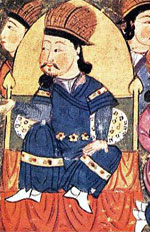 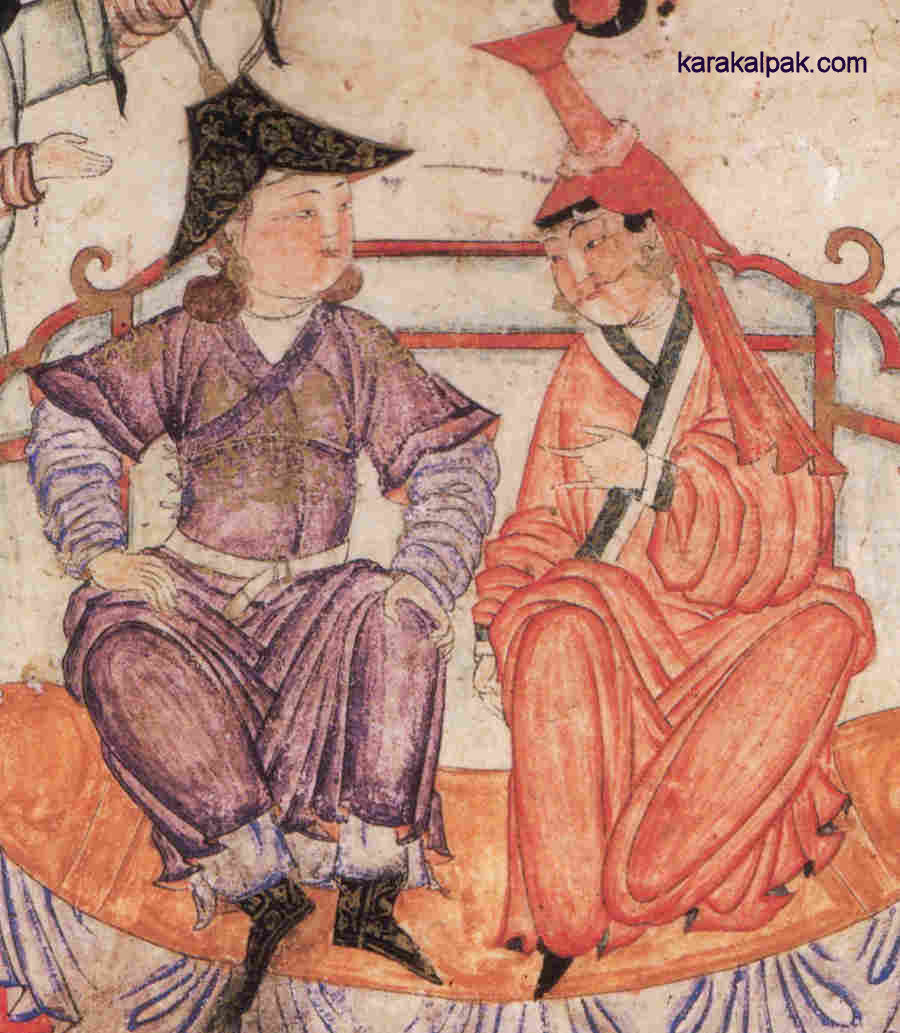 |
| http://karakalpak.com/images/sawboghtaq01.jpg |
You have, in order, the feather hat, the brimmed hat and the fur hat. Everything else I've seen has been variations on these three themes.
The demon hat of Slinky dog is a mix between the fur hat and the brimmed hat. The feather hat shows nobility. The brimmed hat is also a working hat and can be seen as more of a cowboy-style hat at times.
They evolve over time and I plan on making a fleshed out timeline of each hat and when they seem to rise and fall in popularity, as well as where. But, for now, know that they blend and blur into each other because history and fashion are both not straight forward at all. Honestly, it's a good class idea for an event, as an introduction to Mongol men's fashion.
Regardless, though, there's some common themes on how Mongols wore hats that are worth pointing out now.
The biggest common theme is that the ears are usually uncovered. Parts of the ear will be covered, usually the frostbite and sunburn prone tips of the ears (See Ogodei above), but the majority of the ear will be uncovered.
Another theme is that the hats do not sit close to the scalp. There's volume above the head. It's not quite the Burgundian hennin craziness, but there is absolutely gap between the scalp and the crown of the head. It makes the hats look like they sit funny to the modern eye, but it's consistent.
I've only seen one example in art where the hat appears to sit on the scalp and the subject was not of the Mongol tribes, but of another, related ethnic group.
Shoes are much more straightforward.
The shoes I've seen depicted have all basically been the same. They're mid-calf boots without a pointed toe.
I made mention to the slippers I've worn here, but I want to flesh out the ideas a little bit more.
As best as I've been able to tell, the designs on the slipper and the curled toe are both post-period enhancements on the basic shoe design.
The gutal (boots) I've found depictions of have the same basic layout as the slipper, believe it or not. The difference really comes down to toe construction and the boot.
In the examples above, the boots have pretty decent looking heels, even being a little raised. As odd as it sounds, Ugg boots come pretty close to the construction I've seen in extents.
I'm loathe to by Uggs just for events, but I have foot problems (hell yeah high arches! Plantar's Fasciaitis for the win!) so I need a shoe I can put my arch supports in. I may break down and buy (or ask someone to gift me) a pair of man-Uggs. Until then, my lace-up, steel toe combats will have to do.
King's and Queen's Archery and Thrown Weapons
As my blitzkrieg of updating continues today, I wanted to break down the head to toe on my look I wore for K&Q Archery and Thrown yesterday.
This was taken by housemate Simona bat Leon, and is the moment when I was being introduced as Lord Erdene Qadajin for the first time.
I wanted to take a second and breakdown the inspirations for the deel I'm wearing. The hat was detailed in a previous post (Birka 2015) but the deel is completely new.
First, the fabric:
It's a quilter's cotton. I typically use quilter's cotton as a substitute and/or stand in for more historically accurate fabrics for a couple reasons.
The biggest is that quilter's cottons tend to have better patterning on them for my persona than other types of fabrics. I have not yet found a source with what I'm really looking for most of the time, so this is a good approximation of the overall feel. Mongols loved to have their entire wardrobe covered in cloth of gold. Not only would that be prohibitively expensive, but I'd be afraid to touch it, let alone cut it to make a deel.
With quilter's cotton, the applique patterning shines and glints like gold and while it's in negative to what cloth of gold actually looked like, it drives the point home and I'm one of the only people who really knows how cloth of gold actually looks. Yes, I am playing people's ignorance, but it's for science!
The pattern itself is also not a bad patter on this one. It's a floral motif and it isn't paisley. I've seen similar, though larger "print" on some period extant examples. And, it was relatively inexpensive to boot. It was a win all around.
Second is the cut and length:
I've made no secret about being mostly inspired by the Chinese and the Persians for my garb. I rely a good deal (haaaa pun) on the art explosions that happens once the war of conquest settled to figure out what I'm doing -- it's a side effect of the larger, more ongoing work I'm doing regarding prints, depictions and social class which has been influencing my garb more and more.
There's two big things I want to point out.
Firstly, the length I'm sporting appears to be pretty standard. From where modern pants lie when fit properly up to about mid-Achilles tendon are the lengths I've seen for the time period in which I'm playing. I like to go a little longer because the pants I wear, while of period construction, are store bought, mid-weight gi pants. They super comfortable and they are of period construction but it's not hard to tell it was made in a garment factory somewhere.
The second is the sleeve length. There's two sources of inspiration for the length of the sleeve. I've been sliding my persona more and more into being a scholar than a merchant. Merchants are great and they're key to the success on the Silk Route, I don't really think it suits the persona I'm trying to build. I would be more of a scholar in period with what I'm doing and how I'm doing it. Furthermore, as I become more familiar with the time and place, I think shifts in persona are natural.
The length of the sleeve I've seen both in Persian and in Chinese portraiture. The super extended sleeve length comes from an allegorical piece "Mohammad Splitting the Moon" which is a miniature I absolutely love.
There's so much to look at -- the guys checking everything out in the background, the two rubbernecks chillin' with the Prophet. Is the Mongol checking out Mohammed's sweet coat? And who's the guy in light blue there, seemingly oblivious to it all?
Focusing in on the Mongol, who is in orange on the right. If you look at his sleeves, you'll see that they are exaggerated. In period, Mongols didn't wear gloves, but had extended sleeves to act as skin coverage in the extreme and variable weather. It's hard to find it depicted in war scenes, so allegorical ones like these are the best way to see them "in action".
I took a little extrapolation from the figure's right arm (our left side arm) and formulated that the sleeves would go down to about mid-calf if his arms were at his sides. This matches what I've seen for depictions of scholars from China, though I've had a hard time finding any from the Yuan period.
Looking at the photos that are coming out, it appears I nailed the sleeve length from what I've seen. The sleeve is acting the same way in the miniature as it does while I'm standing there, hand over hand. I'd say that's a win.
The sleeve width is blatantly a Chinese ripoff as the Chinese, like me, hated tight sleeves.
I did want to also take a second and reference that I've stopped wearing the slippers. They were fun and all, but they needed to be retired for a couple reasons.
The slippers just aren't period.
I've been unable to support that those shoes were ever worn in period. I've not seen it on any depictions of inside the ger or khan's tent. The upturned toe is also a post-period innovation and I've not been able to support it through anything I've seen. It's an anachronism, but because I am not myself Mongol, it's also a misrepresentation of the evolution of the cultural dress. That's appropriative at that point and a major no-no for me. If I'm going to do it, I want to make sure I do service not only to history, but also to those still living who have Mongol heritage. I am doing work and depicting a time of great cultural pride; to do it wrong is a disservice to those I wish to tribute.
The slippers also are old and starting to get holes.
That I do care less about, but they're also getting worn through and developing holes in many places. Being unable to substantiate their use was something I noticed first, as I don't wear the slippers that often. Then, after the last event I wore them to, I noticed they're beginning to come to the end of their life anyway. I'll still wear them as house shoes until they're completely dead.
What have I done in the meantime about shoes? Well, I'll write another post on that, as I've been doing research into shoes, and hats as I referenced in the Birka 2016 post.
 |
| Their Majesties and I |
This was taken by housemate Simona bat Leon, and is the moment when I was being introduced as Lord Erdene Qadajin for the first time.
I wanted to take a second and breakdown the inspirations for the deel I'm wearing. The hat was detailed in a previous post (Birka 2015) but the deel is completely new.
First, the fabric:
 |
| My new scroll and a close up of my fabric |
It's a quilter's cotton. I typically use quilter's cotton as a substitute and/or stand in for more historically accurate fabrics for a couple reasons.
The biggest is that quilter's cottons tend to have better patterning on them for my persona than other types of fabrics. I have not yet found a source with what I'm really looking for most of the time, so this is a good approximation of the overall feel. Mongols loved to have their entire wardrobe covered in cloth of gold. Not only would that be prohibitively expensive, but I'd be afraid to touch it, let alone cut it to make a deel.
With quilter's cotton, the applique patterning shines and glints like gold and while it's in negative to what cloth of gold actually looked like, it drives the point home and I'm one of the only people who really knows how cloth of gold actually looks. Yes, I am playing people's ignorance, but it's for science!
The pattern itself is also not a bad patter on this one. It's a floral motif and it isn't paisley. I've seen similar, though larger "print" on some period extant examples. And, it was relatively inexpensive to boot. It was a win all around.
Second is the cut and length:
I've made no secret about being mostly inspired by the Chinese and the Persians for my garb. I rely a good deal (haaaa pun) on the art explosions that happens once the war of conquest settled to figure out what I'm doing -- it's a side effect of the larger, more ongoing work I'm doing regarding prints, depictions and social class which has been influencing my garb more and more.
There's two big things I want to point out.
Firstly, the length I'm sporting appears to be pretty standard. From where modern pants lie when fit properly up to about mid-Achilles tendon are the lengths I've seen for the time period in which I'm playing. I like to go a little longer because the pants I wear, while of period construction, are store bought, mid-weight gi pants. They super comfortable and they are of period construction but it's not hard to tell it was made in a garment factory somewhere.
The second is the sleeve length. There's two sources of inspiration for the length of the sleeve. I've been sliding my persona more and more into being a scholar than a merchant. Merchants are great and they're key to the success on the Silk Route, I don't really think it suits the persona I'm trying to build. I would be more of a scholar in period with what I'm doing and how I'm doing it. Furthermore, as I become more familiar with the time and place, I think shifts in persona are natural.
The length of the sleeve I've seen both in Persian and in Chinese portraiture. The super extended sleeve length comes from an allegorical piece "Mohammad Splitting the Moon" which is a miniature I absolutely love.
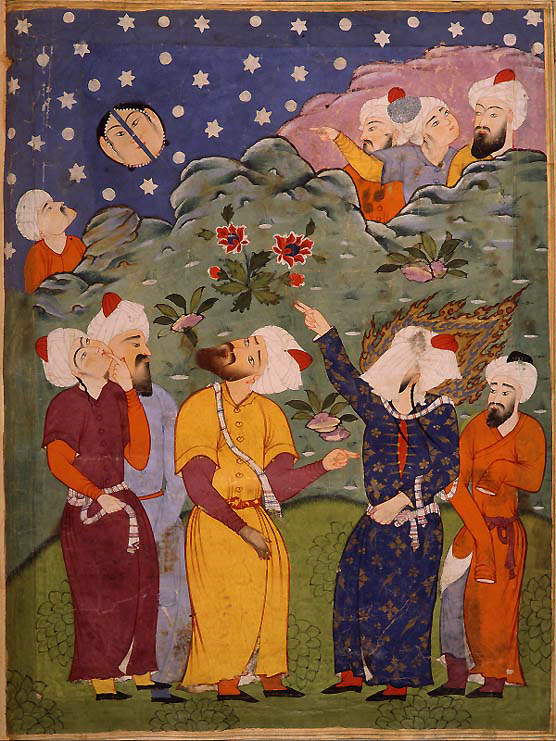 |
| Mohammad is seen with his face covered, the Mongol is on his left Source |
Focusing in on the Mongol, who is in orange on the right. If you look at his sleeves, you'll see that they are exaggerated. In period, Mongols didn't wear gloves, but had extended sleeves to act as skin coverage in the extreme and variable weather. It's hard to find it depicted in war scenes, so allegorical ones like these are the best way to see them "in action".
I took a little extrapolation from the figure's right arm (our left side arm) and formulated that the sleeves would go down to about mid-calf if his arms were at his sides. This matches what I've seen for depictions of scholars from China, though I've had a hard time finding any from the Yuan period.
Looking at the photos that are coming out, it appears I nailed the sleeve length from what I've seen. The sleeve is acting the same way in the miniature as it does while I'm standing there, hand over hand. I'd say that's a win.
The sleeve width is blatantly a Chinese ripoff as the Chinese, like me, hated tight sleeves.
I did want to also take a second and reference that I've stopped wearing the slippers. They were fun and all, but they needed to be retired for a couple reasons.
The slippers just aren't period.
I've been unable to support that those shoes were ever worn in period. I've not seen it on any depictions of inside the ger or khan's tent. The upturned toe is also a post-period innovation and I've not been able to support it through anything I've seen. It's an anachronism, but because I am not myself Mongol, it's also a misrepresentation of the evolution of the cultural dress. That's appropriative at that point and a major no-no for me. If I'm going to do it, I want to make sure I do service not only to history, but also to those still living who have Mongol heritage. I am doing work and depicting a time of great cultural pride; to do it wrong is a disservice to those I wish to tribute.
The slippers also are old and starting to get holes.
That I do care less about, but they're also getting worn through and developing holes in many places. Being unable to substantiate their use was something I noticed first, as I don't wear the slippers that often. Then, after the last event I wore them to, I noticed they're beginning to come to the end of their life anyway. I'll still wear them as house shoes until they're completely dead.
What have I done in the meantime about shoes? Well, I'll write another post on that, as I've been doing research into shoes, and hats as I referenced in the Birka 2016 post.
Birka 2016
It all started with a garb challenge.
This year's Birka Queen's challenge was Pixar inspired. I immediately glommed onto it as one of the ways I like to challenge myself when I'm idling thinking about garb is to convert characters into culturally appropriate inspiration. I may be a nerd, but I'm a multifaceted and creative one.
As a Household, we decided to go with Toy Story as our main inspiration. A bunch of us participated in the challenge -- we had Jesse and Buzz, Etch-a-Sketch, Bo Peep, the Claw Machine Aliens and Partysaurus Rex.
I did this guy:

I thought the colors were nice and in the range of what I like to wear generally, I had an idea as to what I could do for the slinky part and, additionally, I had an idea of what I wanted to do for headgear (spoiler: that was a miserable failure and I think I interpreted the entire hat incorrectly).
But, first, let's see what I did come up with, and was wearable, shall we?
 There I am! All strutting my stuff down the runway at the fashion show.
 Here is a less elegant photo of me so you can see the pattern better.
I'll start with that pattern as it seems, on first glance, to be the most obtrusively modern part of the whole thing. It actually isn't.
I chose Slinky Dog because I had thought of an example of a Mongol on horseback from the Shahnama (book of Kings) credited to Abu'l Qasim Firdausi at the Met:
 The print I found didn't exactly match, but it was close enough to pull the inspiration. You also may have noticed I did some alterations from what's discretely pictured in the source material.
My persona was not yet part of the nobility, haven't had received my AoA at that point in time. From what I've been able to tell, the long-under-short seems to indicate someone of relative wealth and importance, the first step on the ladder up. To accommodate for that, I ditched the specific under deel and went with the the weave pattern of the over deel. Acting above your station was punishable by death to the Mongols at the time and, I take to heart making sure you think with your persona in creating your looks.
Another detail I want to point out is that the sleeves are lined with an embellishment. I've seen this often enough that I typically do it for all my deel. It adds a splash of additional interest and I, frankly, enjoy it.
 Pulling back to how I applied these to the challenge and the way everything relates together, I'm going to refresh your eyes.

The chain link pattern on the main overcoat is the slinky part of the dog. Additionally, the brown is to reference the body, both front and hind, of the toy. My favorite detail I included at the last minute was to add the little bit of brown at the end of the belt. If you look at Slink, you can see that he has a spring for a tail that is capped in the brown plastic. I wanted to keep that to further drive home the inspiration as, on its face, the deel is a bit abstract.
The hat, on the other hand, was an unmitigated disaster from start to finish and I'm taking it as a huge learning opportunity, but for construction and methodology fails.
Obviously Slink is based on a daschund, with his big floppy ears and low profile. It made me think of this hat:


This year's Birka Queen's challenge was Pixar inspired. I immediately glommed onto it as one of the ways I like to challenge myself when I'm idling thinking about garb is to convert characters into culturally appropriate inspiration. I may be a nerd, but I'm a multifaceted and creative one.
As a Household, we decided to go with Toy Story as our main inspiration. A bunch of us participated in the challenge -- we had Jesse and Buzz, Etch-a-Sketch, Bo Peep, the Claw Machine Aliens and Partysaurus Rex.
I did this guy:
I thought the colors were nice and in the range of what I like to wear generally, I had an idea as to what I could do for the slinky part and, additionally, I had an idea of what I wanted to do for headgear (spoiler: that was a miserable failure and I think I interpreted the entire hat incorrectly).
But, first, let's see what I did come up with, and was wearable, shall we?


I'll start with that pattern as it seems, on first glance, to be the most obtrusively modern part of the whole thing. It actually isn't.
I chose Slinky Dog because I had thought of an example of a Mongol on horseback from the Shahnama (book of Kings) credited to Abu'l Qasim Firdausi at the Met:
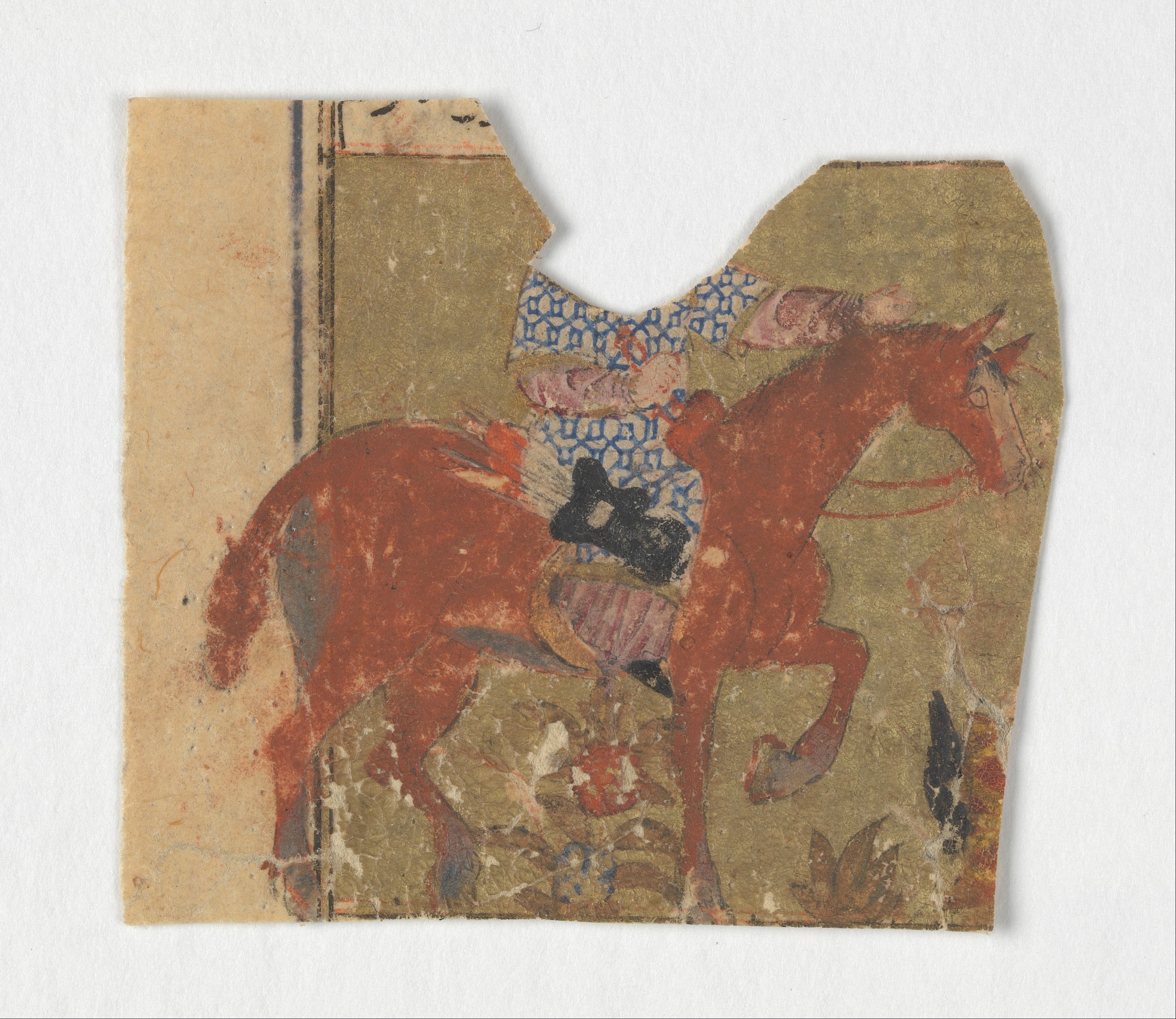
My persona was not yet part of the nobility, haven't had received my AoA at that point in time. From what I've been able to tell, the long-under-short seems to indicate someone of relative wealth and importance, the first step on the ladder up. To accommodate for that, I ditched the specific under deel and went with the the weave pattern of the over deel. Acting above your station was punishable by death to the Mongols at the time and, I take to heart making sure you think with your persona in creating your looks.
Another detail I want to point out is that the sleeves are lined with an embellishment. I've seen this often enough that I typically do it for all my deel. It adds a splash of additional interest and I, frankly, enjoy it.
 Pulling back to how I applied these to the challenge and the way everything relates together, I'm going to refresh your eyes.
The chain link pattern on the main overcoat is the slinky part of the dog. Additionally, the brown is to reference the body, both front and hind, of the toy. My favorite detail I included at the last minute was to add the little bit of brown at the end of the belt. If you look at Slink, you can see that he has a spring for a tail that is capped in the brown plastic. I wanted to keep that to further drive home the inspiration as, on its face, the deel is a bit abstract.
The hat, on the other hand, was an unmitigated disaster from start to finish and I'm taking it as a huge learning opportunity, but for construction and methodology fails.
Obviously Slink is based on a daschund, with his big floppy ears and low profile. It made me think of this hat:

There are several things about this image that are misleading, not least of which is that it looks like a droopy set of dog's ears.
The true problems I had were with fit (too small!) and understanding exactly how the hat was worn (the image is angled). It was a big ol' fail and I've since figure out how to correct it, finding other examples. That would need to be a different post as it's not exactly related.
For good measure to end, here's a photo of most of us in the household.

Subscribe to:
Posts (Atom)